Business Contracts
Distribution Agreement India: Key Clauses, Exclusivity & Legal Guide
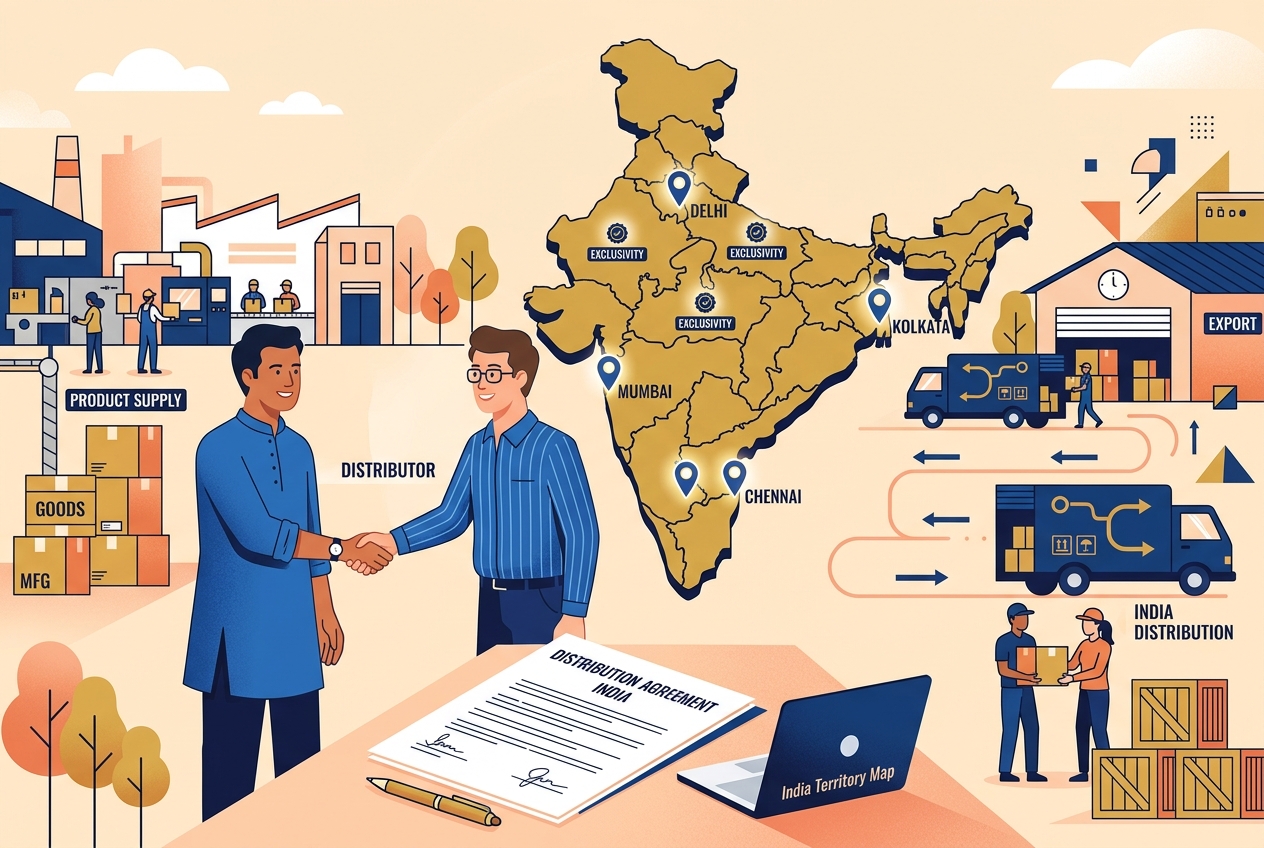
What is an Distribution Agreement?
A distribution agreement is a legal contract that defines the commercial terms, territory, product scope, minimum targets, and payment obligations between a manufacturer and a distributor.
Distributer vs Agent: Critical Legal Distinction
Many businesses confuse the two structures:
- Distributor: Buys goods outright, resells in own name, bears inventory risk, responsible to end customers, earns a margin
- Agent: Acts on manufacturer's behalf, collects commission, manufacturer bears risk and is directly liable to customers
The structure matters for GST, liability, Competition Act compliance, and termination rights. A distributor agreement gives you pricing control through MRP but less day-to-day control over sales activity.
Exclusive vs Non-Exclusive Distribution
- Exclusive: Only one distributor gets the territory. Higher motivation to invest in market development, but manufacturer loses flexibility. Must include minimum performance targets — without them, an exclusive distributor can lock up the territory without selling.
- Non-exclusive: Multiple distributors in the same territory. More competition drives sales activity but creates channel conflicts, price erosion, and grey market risk.
- Sole: Only one distributor, but the manufacturer also retains the right to sell directly in the territory.
10 Essential Clauses in a Distribution Agreement
1. Territory Definition
Define clearly: states, cities, districts, or pin codes. Include whether e-commerce/online sales are included in the defined territory. Vague territory definitions are the #1 source of distributor disputes.
2. Product Scope
List specific SKUs (Stock Keeping Units) covered. Manufacturers reserve the right to introduce new products either within or outside the distribution agreement — state this explicitly to avoid disputes when new products are launched.
3. Minimum Purchase Obligations (MPO)
State minimum quantities/value to be purchased per quarter/year. MPO failure should trigger: (a) loss of exclusivity, (b) right to terminate, or (c) reduction in discount. This is the primary protection against a distributor who locks up a territory passively.
4. Pricing and Discount Structure
Define trade price, MRP, and distributor margins. Note: mandating minimum resale prices is potentially anti-competitive under the Competition Act. You can mandate MRP compliance (legal) but cannot fix minimum selling prices to retailers (risk of RPM violation).
5. Payment Terms
State credit period (typically 30–60 days), late payment interest, and process for disputed invoices. Include: whether payment is advance, on delivery, or post-delivery. Refer to MSME payment rules if your distributor is an MSME.
6. Intellectual Property & Brand Guidelines
Distributor gets a limited right to use manufacturer's trademark/brand for the purpose of distribution only. They cannot: sub-license, modify the brand, create marketing materials without approval, or use the brand for unrelated products. All brand use rights revert on termination.
7. Returns & Defect Policy
Define: what products can be returned (expiry, damage, defect only), return window, refund vs replacement process, and who bears return logistics cost. Without this clause, distributors return slow-moving stock as "defective."
8. Non-Compete & Non-Solicitation
During the agreement: distributor should not distribute competing products without prior consent (list competitor brands explicitly). Post-termination non-compete is void under Section 27 ICA — use non-solicitation of customers instead.
9. Termination and Notice
Define termination triggers: MPO failure, insolvency, brand damage, regulatory violation. Notice period (typically 60–90 days) and what happens on termination: stock buy-back at what price, brand material return, outstanding payment settlement timeline.
10. Dispute Resolution
Most distribution disputes in India go to arbitration. Specify: arbitration institution (DIAC, MCIA), seat (typically the manufacturer's state), language, and number of arbitrators. This avoids state court proceedings which can take years.
Competition Act Compliance
Under the Competition Act 2002, certain distribution clauses trigger scrutiny from the Competition Commission of India (CCI):
- ⚠️ Resale Price Maintenance: Fixing minimum prices distributors charge to retailers — anti-competitive
- ⚠️ Exclusive supply + purchase: Forcing distributors to buy only from you (exclusive purchasing) combined with exclusive supply to only one customer — examined for market foreclosure
- ✅ Territory protection: Generally permissible if it promotes inter-brand competition
- ✅ MRP compliance: Enforcing maximum retail price is legal consumer protection
Protect Your Distribution Channel.
Upload your distribution agreement to ContractShield and identify missing performance clauses, dangerous territory exclusivity gaps, and competition law risks in seconds.
Analyze Your Contract Free →Frequently Asked Questions
What is the difference between an agent and a distributor in India?
An agent acts on behalf of the principal and earns commission; the principal is directly liable to customers. A distributor buys goods outright from the manufacturer and resells in their own name; the distributor is directly liable to customers. Distributors bear more inventory risk but have higher margins. This is subject to the provisions of the Indian Contract Act 1872 and other applicable local regulations, which define the rights, obligations, and legal remedies available to the contracting parties.
Can a manufacturer control the resale price of goods sold to a distributor in India?
Resale price maintenance (RPM) — requiring distributors to sell at fixed prices — is examined under the Competition Act 2002. Hard-core RPM (fixing minimum resale prices) is treated as an anti-competitive practice in India. Manufacturers can suggest MRP but cannot legally enforce minimum prices in most cases. This is subject to the provisions of the Indian Contract Act 1872 and other applicable local regulations, which define the rights, obligations, and legal remedies available to the contracting parties.
What are minimum purchase obligations in a distribution agreement?
Minimum purchase obligations (MPOs) require the distributor to purchase a minimum quantity/value of goods per period. They protect manufacturers from distributors who lock up territory without actively selling. Failure to meet MPOs is typically grounds for termination or loss of exclusivity. According to Section 10 of the Indian Contract Act 1872, agreements are enforceable only when executed with the free consent of parties competent to contract, for a lawful consideration, and with a lawful object.
How long is a typical distribution agreement in India?
Distribution agreements in India typically have an initial term of 1–3 years, with renewal on mutual agreement. Exclusive agreements tend to have shorter initial terms (1 year) with exclusivity tied to minimum performance targets. After the initial term, either party can typically terminate with 60–90 days' notice. According to Section 10 of the Indian Contract Act 1872, agreements are enforceable only when executed with the free consent of parties competent to contract, for a lawful consideration, and with a lawful object.
Are electronic signatures legally valid in Indian contracts?
Yes. Under Section 10A of the Information Technology Act 2000, electronic contracts and digital signatures are legally recognized and enforceable. However, certain documents like negotiable instruments, power of attorney, trust deeds, and wills cannot be executed electronically.