Labour Law & HR
New Labour Codes & Employment Contracts India 2025: What Changes
What is an New Labour Codes & Employment Contracts 2025?
An employment contract defines the terms of employment, compensation, job responsibilities, notice period, confidentiality, and IP assignment between an employer and an employee.
The 4 New Labour Codes: Overview
| Code | Replaces | Key Impact |
|---|---|---|
| Code on Wages 2019 | 4 laws (Minimum Wages Act, Payment of Wages Act, Equal Remuneration Act, Payment of Bonus Act) | Unified 'wages' definition, caps allowances at 50% of CTC |
| Industrial Relations Code 2020 | 3 laws (Trade Unions Act, Industrial Employment Act, Industrial Disputes Act) | Fixed-term employment, retrenchment threshold raised to 300 |
| Code on Social Security 2020 | 9 laws (EPF, ESI, Gratuity, Maternity Benefit, etc.) | Gratuity for short tenures, gig worker coverage |
| OSH, Working Conditions Code 2020 | 13 laws (Factories Act, CLRA, etc.) | Max weekly hours 48, overtime rates, contractor thresholds |
5 Biggest Changes for Employment Contracts
1. New 'Wages' Definition: 50% Cap on Allowances
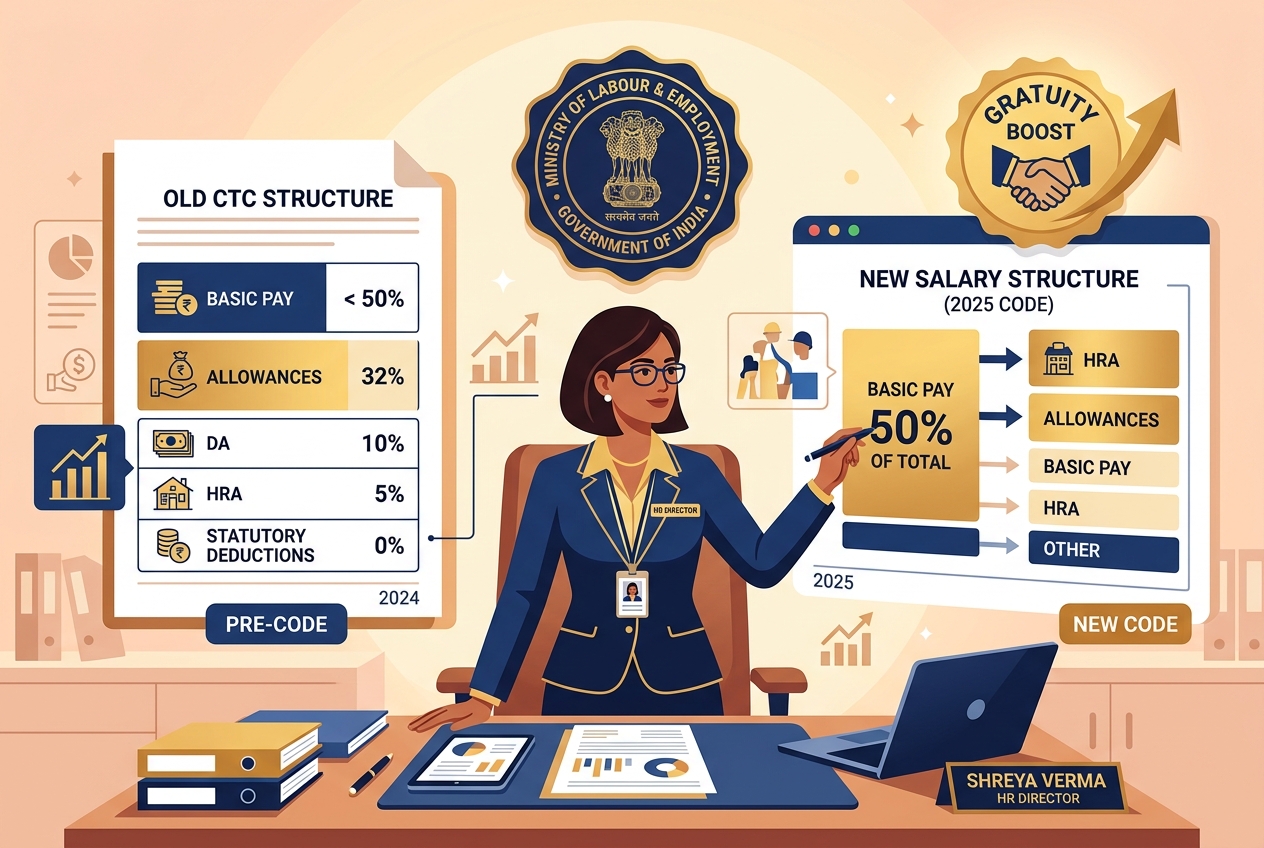
The Code on Wages redefines wages: basic pay + dearness allowance + retaining allowance — and no other allowance can exceed 50% of the total CTC. Companies with allowance-heavy structures (large HRA, Special Allowance) must restructure. Impact: higher basic → higher PF contributions (both employer and employee), higher gratuity base, higher bonus base. CTC structures need to be redesigned before implementation.
2. Fixed-Term Employment Contract (New Concept)
The IR Code introduces statutory fixed-term employment for the first time. Key rules:
• Fixed duration for any type of role (project or otherwise)
• FTE gets all benefits proportional to period of service
• Entitled to gratuity even for tenures less than 5 years (unlike current law)
• No termination notice needed if term expires as scheduled
• Must convert to permanent if role continues after term expiry
This allows project-based hiring with full statutory compliance — without creating permanent employment obligations.
3. Gratuity Timing Changes
The current Gratuity Act requires 5 continuous years of service. The SS Code enables the government to prescribe shorter periods for gratuity eligibility — especially for fixed-term employees (who already get gratuity proportional to their tenure regardless of the 5-year rule). Update employment contracts to reflect revised gratuity calculation for FTE staff.
4. Gig and Platform Worker Recognition
The SS Code formally defines gig workers and platform workers for the first time. Aggregator platforms (cab, food delivery, hyperlocal) must: (a) register all gig workers, (b) contribute to a welfare fund, and (c) provide social security coverage. Gig worker contracts must be updated to include welfare fund disclosure and contribution statements.
5. Retrenchment and Layoff Thresholds
Current law: establishments with 100+ workers need prior government permission for retrenchment/closure. IR Code raises this to 300 workers. For HR contracts: retrenchment clauses that previously required government approval now become self-service for companies under 300 workers. Review and update standing orders and HR policy accordingly.
What to Update in Your Employment Contracts Now
- ✅ CTC structure: ensure allowances ≤50% of total CTC (or prepare restructuring plan)
- ✅ Add fixed-term employment provisions and gratuity clauses for FTE staff
- ✅ Update working hours clauses: maximum 12 hours/day, 48 hours/week under OSH Code
- ✅ Review gig/contractor agreements: platform worker registration and welfare fund obligations
- ✅ Update retrenchment provisions and notice periods (90 days' notice replaces 15-30 days)
- ✅ Review bonus eligibility: Code on Wages changes accounting year definition for bonus
Labour Code Compliance Check.
ContractShield helps companies identify employment contract clauses that will become non-compliant under the new Labour Codes — so you can update proactively, not reactively.
Review Your Contracts Free →Frequently Asked Questions
Are the 4 new Labour Codes in force in India in 2025?
The 4 Labour Codes (Wages, IR, Social Security, OSH) were passed by Parliament in 2019–2020 and received Presidential assent. However, most states have not yet notified the rules, so the old labour laws continue to apply in most states. Companies should monitor their state-specific implementation dates. As of 2025, only Rajasthan, Haryana, and a few other states have partially notified rules.
What is the new definition of 'wages' under the Labour Code on Wages?
The Labour Code on Wages 2019 standardizes 'wages' to mean all basic pay plus allowances — with the key stipulation that allowances cannot exceed 50% of total remuneration. This affects salary structures: companies with high allowance-heavy CTC structures (HRA, Special Allowance >50%) must restructure. Higher basic = higher PF, gratuity, and esa contributions.
What is fixed-term employment under the new Indian Labour Codes?
The Industrial Relations Code 2020 introduces fixed-term employment as a statutory concept. Key features: can hire for any period (project-linked), employee gets all statutory benefits proportional to tenure, entitled to gratuity even for short tenures, no termination notice if term expires, must be converted to permanent if role continues beyond the term. This is a significant tool for project-based hiring.
Does the Labour Code allow retrenchment without government permission?
The IR Code 2020 increases the threshold for mandatory government permission for retrenchment and closure from 100 to 300 workers. Units with fewer than 300 workers can retrench without prior government approval (though severance requirements still apply). States can raise or lower this threshold. This is subject to the provisions of the Indian Contract Act 1872 and other applicable local regulations, which define the rights, obligations, and legal remedies available to the contracting parties.
How does the social security code affect gig workers in India?
The Code on Social Security 2020 is the first Indian law to formally recognize gig workers and platform workers. It enables the government to create welfare funds and extend social security benefits to gig/platform workers. Aggregators (Ola, Zomato, Swiggy, Dunzo types) will be required to contribute to these funds. Implementation rules are still awaited.
Are electronic signatures legally valid in Indian contracts?
Yes. Under Section 10A of the Information Technology Act 2000, electronic contracts and digital signatures are legally recognized and enforceable. However, certain documents like negotiable instruments, power of attorney, trust deeds, and wills cannot be executed electronically.