Government Procurement
Government Tender Contracts India: NIT, Bid Process & Contract Rights
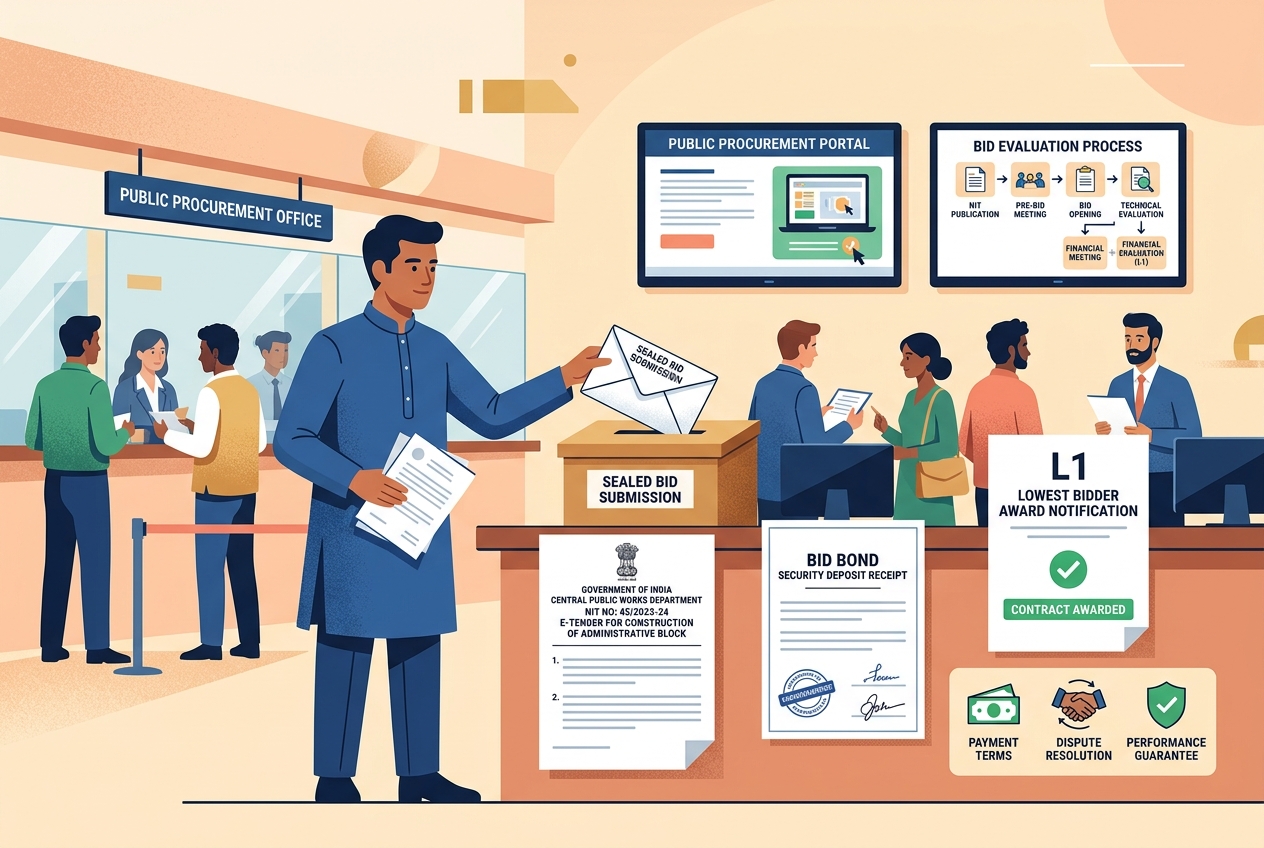
What is an Government Tender Contracts?
A Notice Inviting Tender (NIT) is a formal public advertisement inviting bids, specifying the project scope, eligibility criteria, and submission deadlines for procurement contracts.
The Government Procurement Process: Step by Step
- NIT/RFP Publication: Government issues Notice Inviting Tender on GeM, CPPP, or department portal
- Bid Document Download: Vendors pay document fee and download technical + commercial bid requirements
- Pre-Bid Meeting: Clarifications sought and answered — all Q&A are part of the contract
- EMD Submission: Earnest Money Deposit submitted with bid as refundable security
- Technical Qualification: Bids evaluated for eligibility — experience, financial capacity, certifications
- Commercial Bid Opening: Only technically qualified bidders' prices are opened
- Negotiation (if any): L1 (lowest bidder) may be negotiated further
- Letter of Award (LOA): Formal contract award, triggers performance guarantee requirement
- Contract Agreement Execution: Formal contract signed, project begins
Key Financial Instruments
Earnest Money Deposit (EMD)
Typically 1–2.5% of estimated project value. Refunded to losing bidders after L1 is finalized. Forfeited if: the L1 bidder withdraws after submission, refuses to sign the contract, or fails to furnish performance guarantee. MSME-registered units are typically exempt from EMD — verify department-specific rules.
Performance Bank Guarantee (PBG)
5–10% of contract value, submitted after award. Must be from a scheduled bank. Valid for the contract period + defect liability period (typically 6–12 months after completion). Invoked if contractor abandons project, fails to meet quality standards, or commits material breach. Released on successful project completion and defect liability period expiry.
Security Deposit (SD)
Some contracts deduct 10% of running bills as Security Deposit during execution — in lieu of or in addition to PBG. This cash retention creates cash flow pressure during long projects. Negotiate to reduce SD deduction rate or provide bank guarantee in lieu.
Critical Contract Clauses to Review Before Signing
Termination for Convenience
Most government contracts (GCC clause) allow the government to terminate for convenience with 30 days notice. Compensation: only work done + materials at site. No lost profits claim. This is non-negotiable in government contracts — price it into your bid margins.
Extension of Time (EoT) and Delay Penalties
Liquidated damages (LD): typically 0.5% per week of delay, capped at 10% of contract value. Conversely, time extensions are available for: force majeure, government-caused delays, variations ordered by authority. Always document delays caused by government action — basis for EoT claims and LD waiver.
Arbitration Clause
Government contracts mandate arbitration for disputes. Arbitrator is typically appointed by the government — challenge this in negotiation. Try to include a neutral third-party arbitrator appointment mechanism. The Arbitration and Conciliation Act 1996 governs the proceedings.
Your Rights When Government Acts Unfairly
- 🏛️ Wrongful disqualification: File a writ petition in the High Court under Article 226 — courts actively review arbitrary tender disqualifications
- 🏛️ Arbitrary cancellation: High Court writ if cancellation lacks public interest justification or violates legitimate expectation
- 🏛️ Recovery of EMD: Filed with the arbitrator or civil court if EMD is wrongfully forfeited
- 🏛️ Classification-based exclusion: MSME Act protections for wrongful exclusion of MSMEs from procurement
GeM Portal: Modern Government Procurement
The Government e-Marketplace (GeM) now mandates all Central government procurement above ₹25,000 through the portal. Key advantages: direct OEM pricing, transparent bidding, automated dispute resolution module, and MSME preference features. GeM contracts have standardized terms — less room for negotiation but faster procurement cycles.
Review Government Contracts Carefully.
ContractShield helps businesses identify dangerous clauses in government contracts — LD traps, weak EoT provisions, unfavorable arbitration clauses, and missing compensation entitlements.
Analyze Your Contract Free →Frequently Asked Questions
What is a Notice Inviting Tender (NIT) in India?
A Notice Inviting Tender (NIT) is an official public notice issued by a government authority inviting eligible contractors/vendors to submit bids for a specific project or procurement. The NIT specifies: project description, eligibility criteria, bid submission deadline, EMD (Earnest Money Deposit), and evaluation criteria. It is the gateway document for all government procurement in India.
What is Earnest Money Deposit (EMD) in government tenders?
EMD is a refundable security deposit paid by all bidders to demonstrate serious intent. Typical EMD: 1–2.5% of estimated contract value. Non-refundable if: (a) bidder withdraws after submission during validity period, (b) lowest bidder refuses to sign contract after award, (c) bidder fails to furnish performance guarantee after award. Most MSME/SSI registered units are exempt from EMD — verify state/department-specific rules.
What is a Performance Guarantee in Indian government contracts?
After contract award, the successful bidder must furnish a Performance Bank Guarantee (PBG) — typically 5–10% of contract value as a security deposit for faithful execution. The PBG is invoked if the contractor defaults. It is released after the defect liability period expires. PBGs must be from scheduled commercial banks in India.
Can a government authority cancel a tender after opening bids in India?
Yes. The government has broad discretion to cancel tenders, but this discretion is not unfettered. Courts have held that cancellation must be: (a) for a valid public interest reason, (b) not arbitrary or malicious, (c) accompanied by return of EMD. If you believe a tender was cancelled maliciously to favor another bidder, a writ petition in the High Court is the correct remedy.
How are disputes in government contracts resolved in India?
Government contracts typically include a dispute resolution mechanism: (1) Engineer/Project Manager decision, (2) Appeal to higher authority, (3) Arbitration (GCC/CPWD contracts have mandatory arbitration clauses under IAA/Arbitration Act). Courts can review arbitration awards for perversity. For wrongful disqualification before contract award, writ petitions to High Courts are available. Specifically, Section 17 of the Copyright Act 1957 stipulates that the creator is the first owner of copyright unless there is a written contract assigning these rights to another entity, such as an employer or client.
Are electronic signatures legally valid in Indian contracts?
Yes. Under Section 10A of the Information Technology Act 2000, electronic contracts and digital signatures are legally recognized and enforceable. However, certain documents like negotiable instruments, power of attorney, trust deeds, and wills cannot be executed electronically.