Sale Deed vs Agreement to Sell: Know the Difference or Lose Your Money
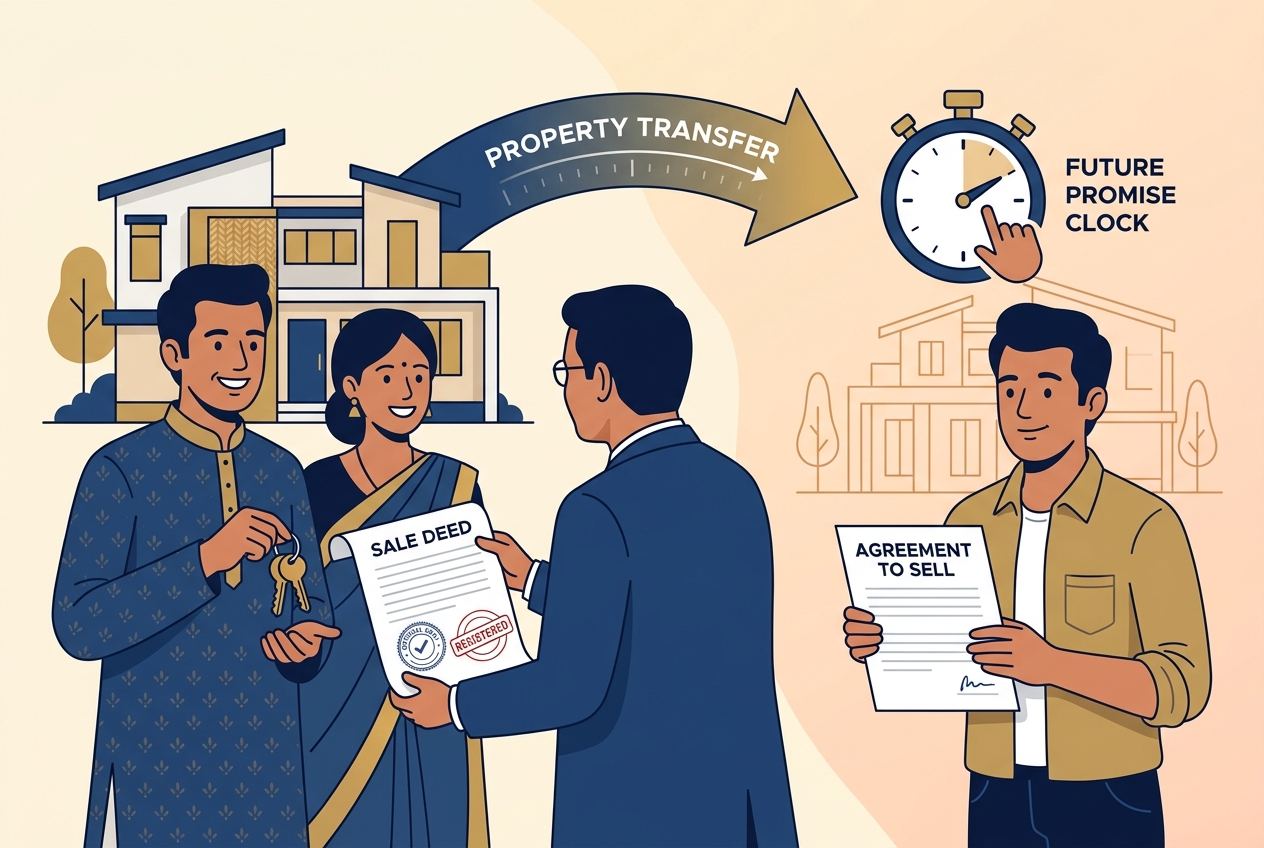
What is an Sale Deed Vs Agreement To Sell?
An agreement to sell is a critical property contract under the Transfer of Property Act 1882 that establishes terms of transfer, earnest money, and mutual covenants before executing the final sale deed.
Understanding the legal distinction is vital to ensure you actually own the property you paid for.
1. Agreement to Sell (The Promise)
This is a preliminary contract. It states that the seller agrees to sell the property to the buyer at a future date, subject to certain conditions (like payment of full amount).
- Ownership: Remains with the Seller.
- Risk: Remains with the Seller.
- Breach: Buyer can sue for specific performance (force the sale) or damages.
2. Sale Deed (The Transfer)
This is the final document executed at the time of full payment and possession handover. It must be:
- Stamped: Stamp duty paid as per state laws.
- Registered: At the Sub-Registrar's office.
- Ownership: Transfers immediately to the Buyer.
3. The Risk of Not Registering
Some people try to save stamp duty by trading only on "Agreement to Sell" + "Power of Attorney". This is illegal and risky. You do not become the legal owner, and the seller can sell the property to someone else.
4. Essential Clauses in Sale Deed
- Indemnity: Seller must indemnify buyer against existing disputes or dues.
- Clear Title: Declaration that the property is free from encumbrances (mortgages, liens).
- Map & Schedule: Precise description of the property boundaries.
Frequently Asked Questions (FAQ)
Can I cancel an Agreement to Sell?
Yes, if the other party breaches the terms (e.g., buyer fails to pay on time). Usually, the earnest money (token amount) is forfeited.
How much is Stamp Duty?
It varies from state to state, typically between 4% to 7% of the property value. Women often get a concession of 1-2%.
Don't Sign Blindly. Protect Yourself.
Templates are just a start. Use Contract Shield's AI to scan your contract for hidden risks, unfair clauses, and Indian legal compliance issues — in 60 seconds.
Analyze Your Contract Free →Frequently Asked Questions
What is the difference between an Agreement to Sell and a Sale Deed?
An Agreement to Sell (Section 54) is a promise to transfer property in the future once conditions are met. A Sale Deed is the actual document that transfers ownership and is registered with the sub-registrar. Specifically, Section 17 of the Copyright Act 1957 stipulates that the creator is the first owner of copyright unless there is a written contract assigning these rights to another entity, such as an employer or client.
Does an Agreement to Sell give me ownership?
No. Ownership only transfers upon the execution and registration of the Sale Deed. Without a registered Sale Deed, the buyer has no legal title to the property. Specifically, Section 17 of the Copyright Act 1957 stipulates that the creator is the first owner of copyright unless there is a written contract assigning these rights to another entity, such as an employer or client.
Is registration mandatory for an Agreement to Sell?
In many states, following recent legal amendments, even an Agreement to Sell must be registered and stamped if possession is being handed over to the buyer. According to Section 10 of the Indian Contract Act 1872, agreements are enforceable only when executed with the free consent of parties competent to contract, for a lawful consideration, and with a lawful object.
Are electronic signatures legally valid in Indian contracts?
Yes. Under Section 10A of the Information Technology Act 2000, electronic contracts and digital signatures are legally recognized and enforceable. However, certain documents like negotiable instruments, power of attorney, trust deeds, and wills cannot be executed electronically.