Employment
Are Employment Bonds Legal in India? Rules & Enforcement
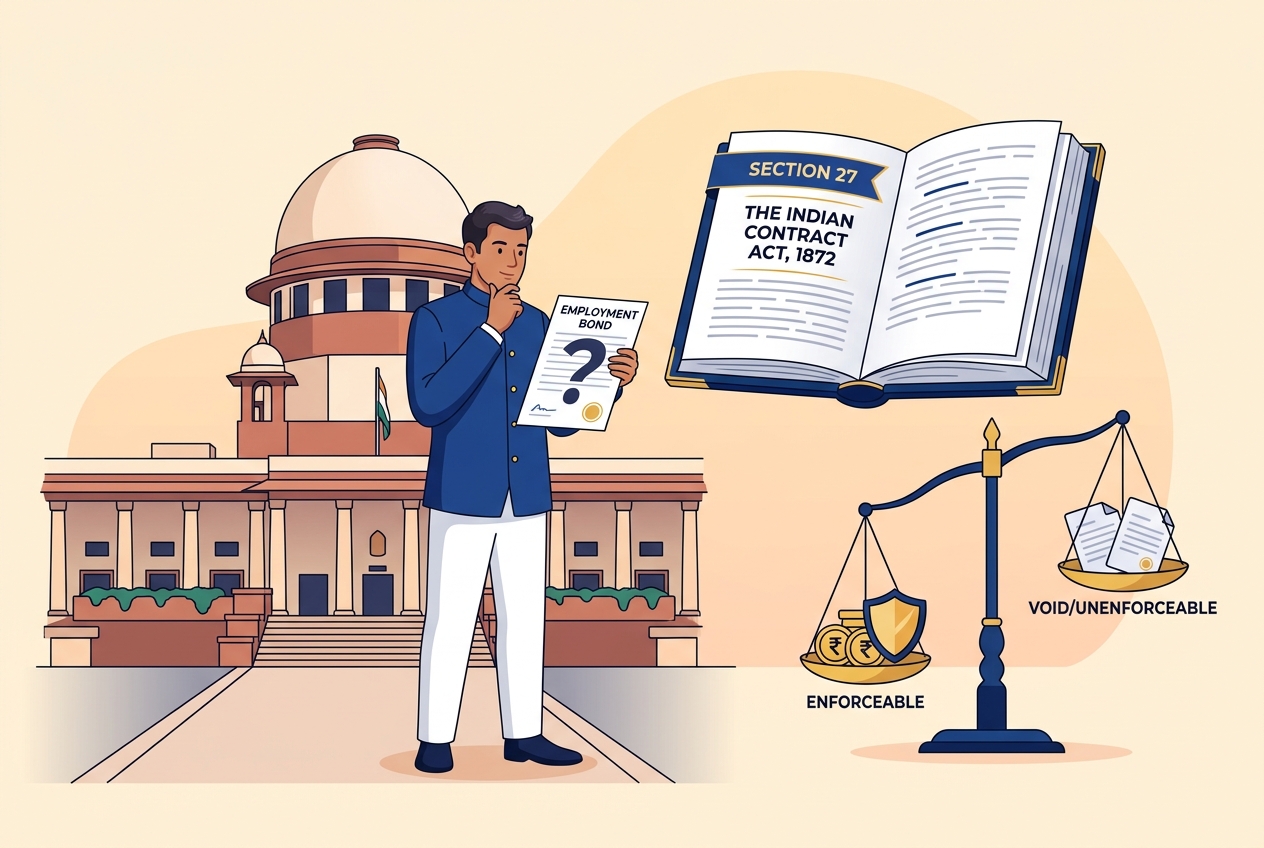
Is an Employment Bond Legal in India?
Yes — employment bonds are conditionally legal under the Indian Contract Act, 1872. Courts will enforce them only when the employer incurred real, provable training costs and the bond amount is a genuine pre-estimate of those losses — not a penalty clause designed to trap an employee.
What Is an Employment Bond?
An employment bond (also called a service bond or training bond) is a clause in an offer letter or a separate agreement that requires an employee to work for the company for a minimum period — typically 1 to 3 years. If the employee leaves before that period ends, they must pay a pre-specified sum to the employer. In India, these are most common in IT services companies, BPOs, manufacturing plants, and any business that invests heavily in skill-specific onboarding.
The legal foundation for employment bonds is derived from Sections 73 and 74 of the Indian Contract Act, 1872, which deal with compensation for breach of contract. Section 74 specifically allows parties to agree on a sum payable as "liquidated damages" — but Indian courts have consistently held that such sums must be a reasonable estimate of actual loss, not a punitive deterrent.
When Are Employment Bonds Unenforceable?
Indian courts — from the Bombay High Court to the Supreme Court — have struck down employment bonds that fail the following tests:
- No actual training expenditure: If the employer cannot produce invoices, third-party training costs, or certifications showing real money was spent, the bond is unenforceable.
- Disproportionate amount: A ₹5 lakh bond for a ₹12,000/month fresher who received a 2-day orientation will be rejected as a penalty clause.
- Post-employment restraint camouflaged as a bond: Some employers use a "bond" to prevent employees from joining competitors. This falls under Section 27 of the Indian Contract Act, which voids any agreement that restrains a person from exercising a lawful profession.
- Signed under duress: If an employee signs a bond on their first day with no realistic ability to negotiate, courts may treat their consent as not "free" under Section 14 of the Contract Act.
Key Conditions for a Legally Enforceable Bond
Actual, Documented Training Cost
The employer must be able to demonstrate — with receipts and timesheets — what was spent on the employee's training or onboarding. Without documentation, no court will award the full bond amount.
Reasonable Lock-In Period
A 1-year bond for a ₹1 lakh training investment is reasonable. A 3-year bond for a 3-day induction is not. The duration must be proportional to the benefit conferred.
No Total Restraint of Trade
The bond can require an employee to stay or pay damages — but it cannot legally prevent the employee from finding work elsewhere or practicing their profession. If it does, it violates Section 27.
Freely Negotiated Terms
Both parties must have had the opportunity to read and negotiate the terms. Bonds buried in 50-page offer letters and signed under time pressure are frequently challenged successfully.
Landmark Case Law on Employment Bonds in India
Several High Court decisions shape how employment bonds are treated in India today:
- Niranjan Shankar Golikari v. The Century Spinning and Mfg. Co. Ltd. (1967, SC): The Supreme Court upheld a negative covenant restricting an employee from working for a competitor during the contract period, but made clear this applied only to the duration of service — not after.
- Gujarat Bottling Co. Ltd. v. Coca-Cola Co. (1995, SC): Reaffirmed that restraints operating after the expiry of a contract are void under Section 27 of the Indian Contract Act.
- Bombay High Court (2010) — Sicpa India Ltd.: A bond requiring an employee to pay 12 months' salary on early exit was held to be a penalty clause and unenforceable as it had no nexus to actual loss.
State-Specific Considerations
Some Indian states have Shop and Establishment Acts that place additional restrictions on employment terms. For example, Karnataka's Shops and Commercial Establishments Act and the Maharashtra Shops and Establishments (Regulation of Employment and Conditions of Service) Act give employees certain statutory protections that cannot be contracted away — including the right to resign on adequate notice. Any bond that restricts this right is void in those states regardless of the contract terms.
How Courts Calculate the Bond Amount
Even when a court upholds a bond in principle, the enforced amount is rarely the full sum stated. Indian courts apply the "reasonable compensation" principle from Section 74 — they independently assess:
- Actual training expenditure incurred by the employer
- Duration of service rendered before resignation
- Proportion of the bond period served
- Whether the employer suffered any real business disruption
For example, if an employee leaves after 8 months of a 12-month bond, a court may award 4 months' worth of pro-rated training cost — not the lump-sum penalty written in the agreement.
Practical Steps If You Are Asked to Sign a Bond
- Request a detailed breakdown of the training costs being cited as justification for the bond amount
- Negotiate the bond amount and lock-in duration before signing — these are not fixed by law
- Check whether the bond attempts to restrict you from working in your industry after leaving (Section 27 violation)
- Ensure the bond only covers the period of employment, not the post-resignation period
- Get a copy of the signed agreement — you are legally entitled to one
What Happens If You Break the Bond?
If you resign before the bond period ends, the employer can file a civil suit for damages in the appropriate court. The employer cannot arrest you or prevent you from joining another company — that would constitute unlawful restraint. However, they may:
- Withhold your relieving letter and experience certificate (this practice itself is increasingly being challenged in courts)
- File a money recovery suit for the bond amount in civil court
- Attempt to have you restrained from joining a competitor (rarely successful post-employment)
In practice, most employers do not pursue litigation over small bond amounts because the legal costs outweigh the recovery. However, for high-value bonds (₹5 lakh+), litigation is more common, especially in IT services firms.
Review Your Employment Bond
Don't sign an illegal bond. Use Contract Shield to analyze your offer letter or employment agreement for predatory clauses in under 60 seconds.
Analyze My Employment Bond →Frequently Asked Questions
Are non-compete clauses valid in India?
Under Section 27 of the Indian Contract Act, 1872, any agreement that restrains anyone from exercising a lawful profession, trade, or business is void. This means post-employment non-competes are generally unenforceable in India. According to Section 10 of the Indian Contract Act 1872, agreements are enforceable only when executed with the free consent of parties competent to contract, for a lawful consideration, and with a lawful object.
What is the standard notice period in India?
Typically, notice periods range from 30 to 90 days. For employees on probation, it's often shorter (15-30 days). This is subject to the provisions of the Indian Contract Act 1872 and other applicable local regulations, which define the rights, obligations, and legal remedies available to the contracting parties. This is subject to the provisions of the Indian Contract Act 1872 and other applicable local regulations, which define the rights, obligations, and legal remedies available to the contracting parties.
Can an employer reduce my salary during the contract term?
Generally, no. A unilateral reduction in salary without a corresponding amendment signed by the employee can be challenged as a breach of contract. This is subject to the provisions of the Indian Contract Act 1872 and other applicable local regulations, which define the rights, obligations, and legal remedies available to the contracting parties.
Are employment bonds legal and enforceable in India?
Yes, but with strict conditions. Under Section 74 of the Indian Contract Act 1872, an employment bond is enforceable only if the recovery sum is a reasonable pre-estimate of actual training expenses incurred by the employer, not a penalty. Courts will not enforce bonds that impose disproportionate exit costs or operate as forced labour.