Director's Duties & Liabilities in India: Avoid Heavy Penalties (2026)
What is an Director'S Duties & Liabilities In?
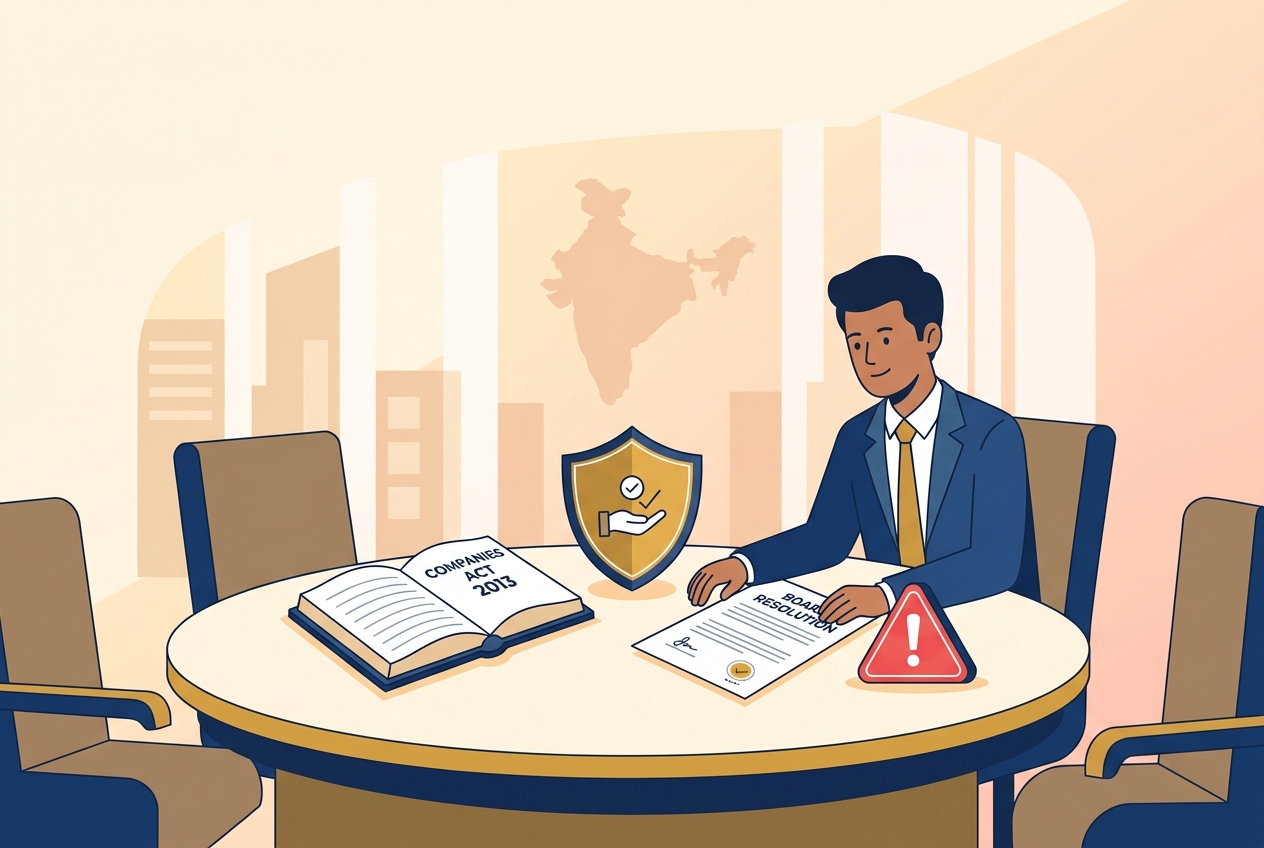
Directors' duties and liabilities under Section 166 of the Companies Act 2013 require company directors to act in good faith, exercise due care, avoid conflicts of interest, and bear personal liability for negligence.
Ignorance is not an excuse. Directors can be held personally liable, fined, or even imprisoned for non-compliance by the company.
1. Key Duties under Section 166
- Duty to act in accordance with Articles: You cannot bypass the Articles of Association (AoA).
- Duty to exercise reasonable care: You must exercise independent judgment and skill. You cannot just rubber-stamp decisions.
- Duty to avoid conflict of interest: You cannot be involved in a situation where you have a direct or indirect interest that conflicts with the company.
- Duty not to achieve undue gain: You generally cannot make secret profits from your position.
2. Liabilities & Consequences
If a director contravenes the provisions of Section 166, such director shall be punishable with fine which shall not be less than ₹1 Lakh but which may extend to ₹5 Lakhs.
3. Disqualification of Directors (Section 164)
You can be disqualified for 5 years if:
- The company fails to file financial statements or annual returns for any continuous period of 3 financial years.
- The company fails to repay deposits or pay interest or redeem debentures.
Frequently Asked Questions (FAQ)
Can a director resign to avoid liability?
Resignation does not absolve a director from liability for acts or omissions that occurred during their tenure. You remain liable for past actions.
Are independent directors liable?
They have some protection. They are liable only for acts of omission or commission by a company which had occurred with their knowledge, attributable through Board processes, and with their consent or connivance.
4. Criminal Liability for Directors Under Other Laws
Beyond the Companies Act 2013, directors can face criminal liability under several other Indian statutes:
- Income Tax Act, 1961: Directors are personally liable for the company's tax arrears if they were in charge at the time the tax was due (Section 179). The liability is joint and several with the company.
- GST Act, 2017: If the company fails to deposit collected GST, directors can be prosecuted under Section 122 and 132. Penalties include imprisonment up to 5 years.
- FEMA, 1999: Directors are personally liable for foreign exchange violations committed by the company during their tenure.
- Environmental Laws: Directors can be personally prosecuted under the Environment Protection Act, 1986 if the company causes environmental damage due to willful neglect or inaction.
- Labour Laws: Under the Employees' Provident Fund Act and ESIC Act, directors are personally liable for the company's contribution defaults.
5. Related Party Transactions and Section 188
Section 188 of the Companies Act, 2013 regulates transactions between the company and its related parties (directors, their relatives, companies in which they hold interest). Key compliance requirements:
- Board approval required for any related party transaction not in the ordinary course of business or not at arm's length.
- Shareholder approval required for transactions above specified thresholds (10% of net worth or turnover, whichever is lower).
- Interested directors must abstain from the board vote on the transaction.
- Penalties for non-compliance: The company faces a fine of Rs 25 lakh and the director faces imprisonment up to 1 year or a fine of Rs 5 lakh.
Directors should maintain a register of related party transactions and ensure all such transactions are disclosed in annual reports as required under Schedule V.
6. Directors' and Officers' (D&O) Insurance in India
Given the scope of director liability under Indian law, Directors' and Officers' (D&O) insurance has become essential for companies of all sizes. D&O insurance covers:
- Legal costs of defending claims brought against directors personally.
- Damages awarded against directors in civil suits.
- Regulatory investigation costs (SEBI, ROC, CCI investigations).
- Employment practices liability (wrongful termination, discrimination claims by employees).
D&O insurance does NOT cover: criminal fines, fraud, intentional misconduct, or claims arising from conduct predating the policy period. For startup founders and directors of PE/VC-backed companies, D&O insurance is now frequently required by investors as a condition of funding.
7. Practical Checklist for Directors to Stay Compliant
- ✅ Attend board meetings regularly. Absences from all meetings for 12 consecutive months trigger automatic vacation of office under Section 167.
- ✅ Disclose interests in any contract or arrangement at the first board meeting after becoming interested (Section 184).
- ✅ Review financial statements before signing — do not blindly sign documents placed before you at board meetings.
- ✅ Ensure annual filings are current — non-filing of annual returns or financial statements for 3 consecutive years results in director disqualification under Section 164(2).
- ✅ Verify PAN and DIN are active — deactivated DIN prevents you from acting as director and may result in penalties for the company.
- ✅ Do not lend to directors — Section 185 prohibits loans to directors or companies in which directors hold interest (with narrow exceptions). Violation attracts criminal prosecution.
Don't Sign Blindly. Protect Yourself.
Templates are just a start. Use Contract Shield's AI to scan your contract for hidden risks, unfair clauses, and Indian legal compliance issues — in 60 seconds.
Analyze Your Contract Free →