Data Privacy • DPDP Act 2023
DPDP Act 2023 Contract Compliance: 8 Mandatory Clauses to Update Now (2026)
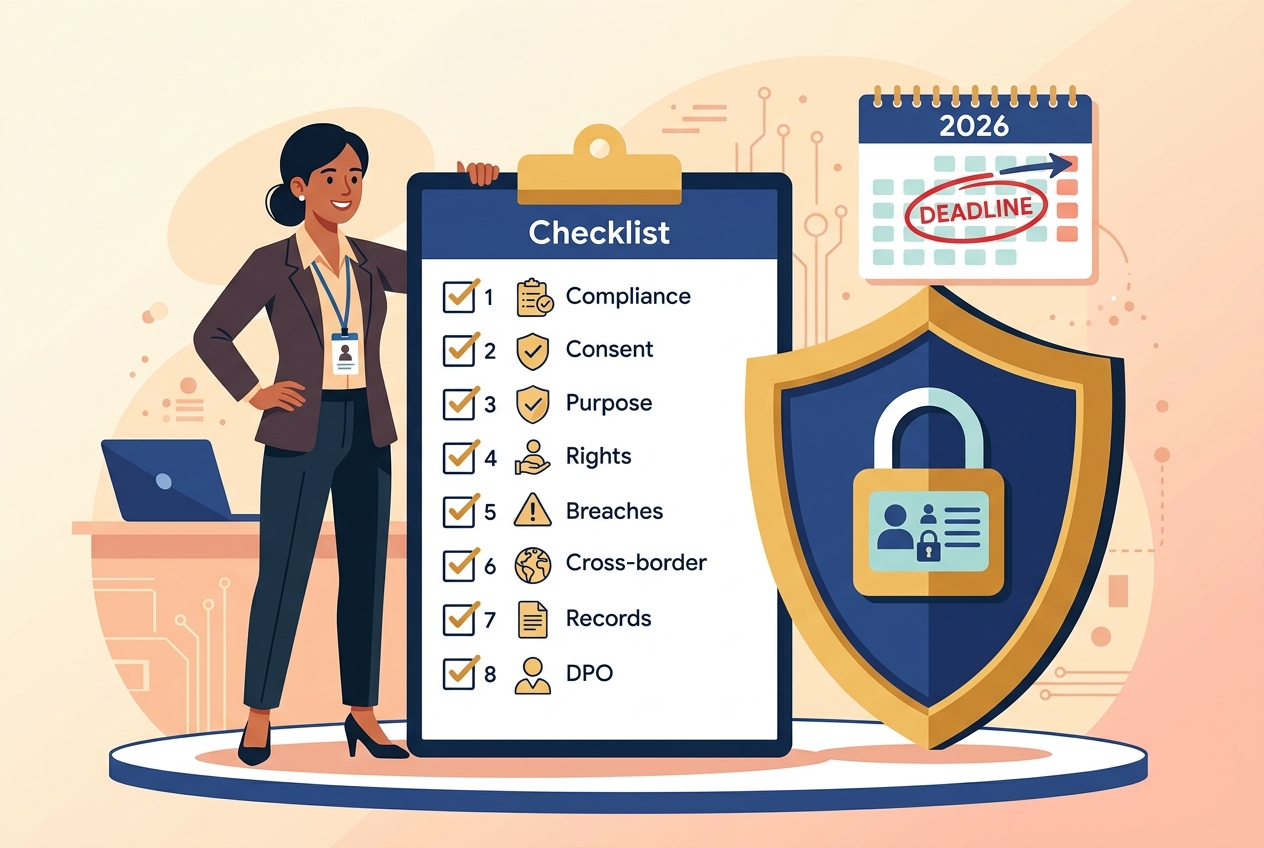
Summary: How Does the DPDP Act 2023 Impact Commercial Contracts in India?
India's Digital Personal Data Protection (DPDP) Act, 2023 fundamentally alters contract law for any business handling customer, vendor, or employee data. Under Section 8(2), a Data Fiduciary is statutorily prohibited from engaging a Data Processor without a valid written contract (Data Processing Agreement). Failing to enforce security standards or report breaches carries crippling penalties up to ₹250 Crore per violation. Organizations must immediately update vendor MSAs, employment agreements, and SaaS terms with mandatory audit, consent, breach response, and data erasure clauses.
When the President of India gave assent to the Digital Personal Data Protection Act, 2023 (DPDP Act), it brought an end to India's unregulated digital data era.
Unlike the European Union's GDPR, which offers broad de minimis discretion and extensive transition periods, India's DPDP Act features some of the highest statutory financial penalties in corporate history: up to ₹250 Crore per incident.
Crucially, the Act does not merely govern external customer consent forms and privacy policies on websites. It explicitly dictates the mandatory legal terms of your commercial contracts. If you share user data with an AWS cloud hosting provider, an Indian payroll agency, a CRM platform, or a marketing consultant without an updated DPDP contract, you are in direct violation of Section 8 of the Act.
Below is the complete 2026 contract compliance manual: the contracts that must change, the 8 mandatory clauses, sample drafting language, and a complete compliance checklist.
1. The Four Commercial Contracts You Must Update Immediately
| Contract Type | Why It Must Change | Core Regulatory Risk |
|---|---|---|
| 1. Vendor & SaaS Agreements (DPA) | Section 8(2) mandates that processors may only process personal data under a valid contract specifying instructions and security controls. | Direct corporate liability for vendor data leaks (up to ₹250 Cr). |
| 2. Employment Contracts & HR Handbooks | Employee data (PAN, Aadhaar, biometrics, bank accounts) is digital personal data. Consent must be itemized; background check clauses must be compliant. | Grievances before the Data Protection Board of India (DPBI). |
| 3. B2B Client MSAs (Master Service Agreements) | Enterprise clients now demand contractual indemnity for data handling, specific breach notification windows (24–72 hrs), and audit rights. | Loss of enterprise deals and immediate client termination. |
| 4. Website Terms & Digital Consent Schedules | Section 5 & 6 prohibit bundled or deceptive "dark pattern" consent. Consent must be free, specific, informed, unconditional, and unambiguous. | Penalties up to ₹50 Crore for defective consent architecture. |
2. The 8 Mandatory DPDP Clauses Every Agreement Must Include
Legal Imperative: Prevents the vendor from claiming independent ownership or commercial exploitation rights over your customer database.
Statutory Basis: Under Section 8(6), the Data Fiduciary is legally obligated to inform the Data Protection Board and affected users. A 24-hour vendor reporting window is essential to avoid missing statutory regulatory deadlines.
Is Your Website and Contract Suite DPDP Compliant?
Run ContractShield's automated Indian Legal Scanner on your website and contracts. We scan cookie policies, consent banners, DPA schedules, and penalty liabilities in 60 seconds.
Scan Your Business Free →3. Statutory Penalty Breakdown Under DPDP Act 2023
The Schedule to the Act sets out unambiguous statutory caps for non-compliance:
| Nature of Breach / Violation | Statutory Section | Maximum Penalty (Schedule) |
|---|---|---|
| Failure to take reasonable security safeguards to prevent a Personal Data Breach | Section 8(5) | Up to ₹250 Crore |
| Failure to notify the Board and Data Principals of a Personal Data Breach | Section 8(6) | Up to ₹200 Crore |
| Breach in observance of additional obligations regarding children's data | Section 9 | Up to ₹200 Crore |
| Breach in observance of obligations of Significant Data Fiduciaries (SDFs) | Section 10 | Up to ₹150 Crore |
| Breach of any other provision of the Act or rules thereunder | General Residual | Up to ₹50 Crore |
4. Step-by-Step Contract Remediation Checklist
To protect your business before the Data Protection Board of India begins enforcement:
- Map Data Flows: Catalog every third-party software, cloud server, payment gateway, and outsourced partner that handles personal data.
- Execute a DPA Addendum: Issue a standardized Data Processing Addendum (DPA) incorporating Clauses 1–8 to all current vendors and customers.
- Revise Employment Agreements: Replace broad, perpetual employee consent clauses with clear, itemized processing disclosures covering HR and payroll.
- Audit Cyber Liability Caps: Standard contract clauses capping liability at "fees paid in past 3 months" will leave you entirely exposed to a ₹250 Crore regulatory fine caused by a vendor's negligence. Ensure your data indemnity is excluded from the general limitation of liability cap!
Explore Free ContractShield Legal Templates
Download lawyer-drafted service agreements, NDAs, and commercial contracts complete with proper dispute resolution clauses.
View Legal Templates Catalog →Frequently Asked Questions
What are the penalties for non-compliance under the DPDP Act 2023?
Under the Schedule to the DPDP Act 2023, penalties are severe and reach up to ₹250 Crore for failing to take reasonable security safeguards to prevent a personal data breach, up to ₹200 Crore for failure to notify the Data Protection Board and affected users, and up to ₹200 Crore for non-compliance with child data protection requirements.
Which contracts must be amended under the DPDP Act 2023?
Any contract involving the collection, storage, transfer, or processing of digital personal data must be updated. This includes vendor and cloud SaaS agreements, master service agreements (MSAs), employment contracts, HR policies, marketing agency agreements, and customer terms of service.
Can a Data Fiduciary process personal data through a third party without a contract?
No. Under Section 8(2) of the DPDP Act, 2023, a Data Fiduciary is statutorily prohibited from engaging, appointing, or using a Data Processor to process personal data on its behalf except under a valid written contract (Data Processing Agreement).
Does the DPDP Act allow cross-border transfer of personal data?
Under Section 16 of the DPDP Act 2023, personal data may generally be transferred outside India unless the Central Government restricts transfers to specific countries or territories placed on a 'blacklisted' negative list.
What is the role of a Data Protection Officer (DPO) under the DPDP Act?
Significant Data Fiduciaries (SDFs) designated by the government must appoint an India-based Data Protection Officer who represents the entity before the Data Protection Board of India, oversees compliance, and handles user grievances.