Employment
Human Review vs AI Contract Analysis: A Complete Comparison
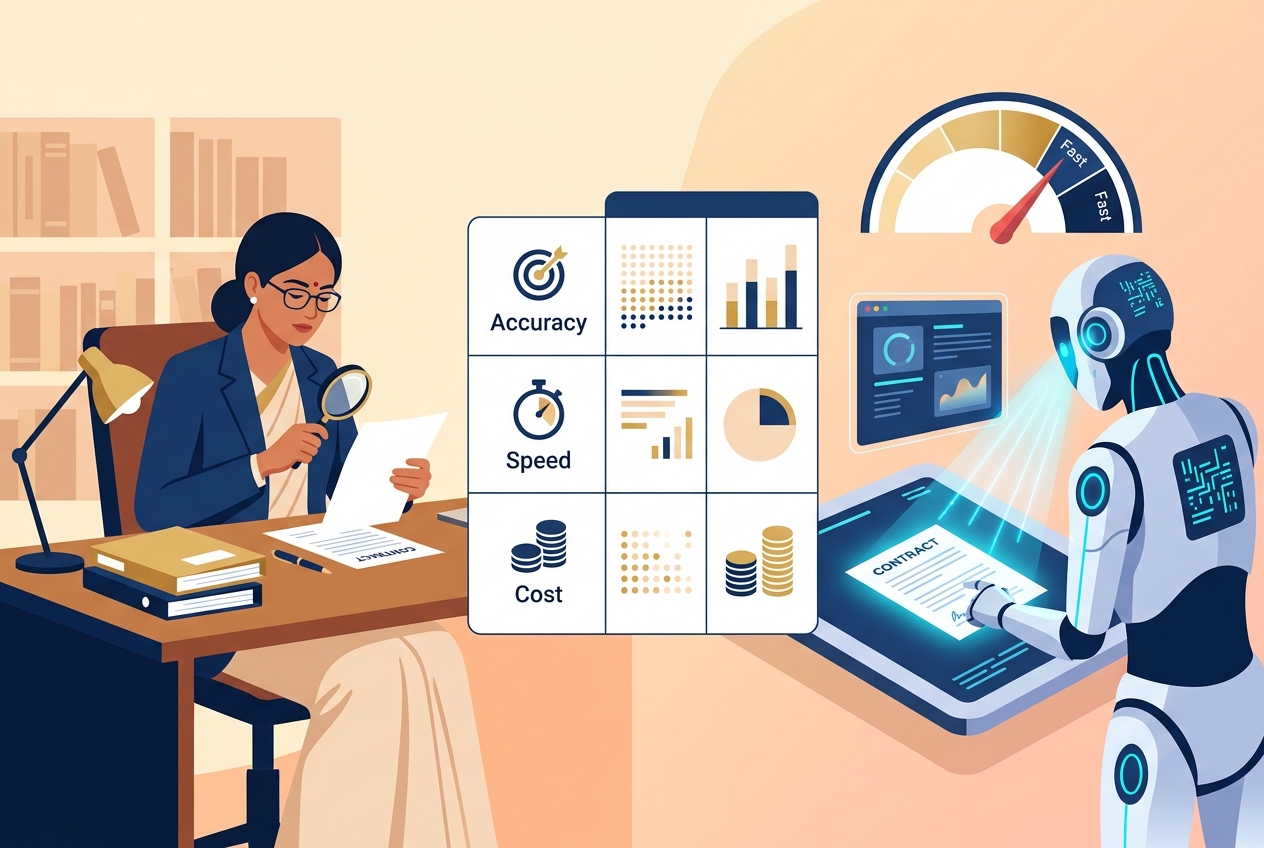
Human vs AI Contract Analysis: Which Is Better for Indian Businesses?
AI contract analysis tools can review a standard agreement in under 60 seconds, identify risks, flag non-standard clauses, and benchmark terms against market norms. Human lawyers bring contextual judgment, negotiation skill, and accountability. For most Indian businesses in 2026, the optimal approach is a hybrid model: AI for speed and consistency, human oversight for high-stakes decisions.
The Lawyer's Advantage: Where Human Review Is Irreplaceable
A seasoned Indian corporate lawyer brings capabilities that no AI system currently matches:
- Contextual risk judgment: A lawyer knows that an indemnity clause that is fine in a SaaS agreement between two large companies is dangerous in a founder's agreement with an uncapped liability clause for a bootstrapped startup.
- Negotiation strategy: Lawyers can advise on what to push back on, what to concede, and how to reframe a clause to achieve the same commercial outcome with less risk.
- Jurisdiction-specific knowledge: India has 28 states with different contract-related regulations (stamp duty, local shops acts, state-specific RERA rules). A good lawyer knows which jurisdiction your specific agreement should be governed by and why.
- Professional accountability: A human lawyer carries professional liability. If they miss something material, you have legal recourse under the Bar Council of India rules and civil tort law.
- Relationship-aware advice: Is this a key supplier you don't want to antagonize? A lawyer can calibrate how firmly to push back based on your business relationship — AI cannot.
The AI Advantage: Speed, Consistency, and Cost
Modern AI contract analysis tools — trained on tens of thousands of Indian and international commercial agreements — offer distinct advantages for routine contract review:
- Speed: A 20-page vendor agreement that takes a lawyer 2–4 hours to review can be processed in under 60 seconds, with key risk flags highlighted instantly.
- Consistency: AI applies the same ruleset to every contract, every time. Human reviewers — even experienced ones — may miss clauses on a Friday afternoon or in a complex multi-schedule agreement they skimmed under deadline pressure.
- Cost: A lawyer reviewing a standard NDA charges ₹5,000–₹25,000 depending on the firm. AI analysis costs a fraction of that — critical for startups and SMEs reviewing dozens of vendor agreements monthly.
- Pattern recognition at scale: AI can detect patterns across hundreds of contracts simultaneously — useful for bulk due diligence in M&A or compliance audits.
- Always available: AI tools work at 2 AM before a 9 AM deadline. A senior partner does not.
Head-to-Head Comparison
| Factor | Human Lawyer | AI Analysis Tool |
|---|---|---|
| Standard NDA Review Time | 2–4 hours | < 60 seconds |
| Cost per Agreement | ₹5,000–₹25,000 | ₹50–₹500 |
| Consistency | Variable (fatigue, bias) | High (rule-based) |
| Negotiation Advice | ✅ Expert | ⚠️ Limited |
| India-specific Law (Stamp Act, GST, DPDP) | ✅ Full coverage | ✅ If trained on Indian law |
| Availability | Business hours | 24/7 |
| Professional Liability | ✅ Yes (Bar Council) | ❌ No |
| Scales with Volume | ❌ Expensive to scale | ✅ Linear cost |
The Recommended Hybrid Model for Indian Businesses
The most pragmatic approach for 2026 is a tiered model based on contract value and risk:
- Low-value, high-volume contracts (NDAs, standard vendor agreements, POA forms): AI-first review. Flag anomalies for human attention. No routine lawyer involvement needed.
- Mid-value contracts (service agreements, software licensing, employment contracts < ₹1 Cr annual value): AI identifies risks; in-house legal or junior lawyer reviews flagged sections only. Reduces review time by 70%.
- High-stakes agreements (M&A, fundraising term sheets, JV agreements, real estate): Full human review mandatory. AI used for first-pass risk flagging and clause library comparison — not as a replacement.
What Indian Regulators Say About AI in Legal Services
As of 2026, the Bar Council of India has not issued formal guidelines restricting AI use in contract review. AI tools that assist lawyers — rather than replace them — are broadly accepted. The DPDP Act 2023 adds a data privacy layer: any AI tool that processes client contracts must handle that data in compliance with its data localisation and consent provisions.
Real-World Use Cases: Indian Businesses Using AI for Contracts
Across India's startup and SME ecosystem, AI contract analysis is already being deployed in specific high-value scenarios:
- Bulk NDA review (IT services firms): A mid-size IT services company with 200+ vendor NDAs per year saved over 600 hours of associate lawyer time in the first year by using AI for first-pass NDA review — reducing full legal review to only NDAs flagged by AI as "high risk."
- Employment contract standardisation: A funded startup used AI analysis to identify that 23 of their 80 offer letters had inconsistent notice period clauses — some saying 30 days, others 90 days — creating a legal liability they were unaware of.
- Pre-M&A due diligence: PE firms in India now routinely use AI tools to process the data rooms of acquisition targets — reviewing hundreds of vendor, customer, and IP agreements in parallel to flag change-of-control triggers, uncapped liabilities, and assignment restrictions.
- DPDP Act compliance audit: With the Digital Personal Data Protection Act 2023 now in force, companies are using AI to scan vendor agreements for data processing clauses that may need updating to include DPDP-compliant data processing agreements (DPAs) and sub-processor restrictions.
Limitations of AI Contract Analysis You Must Know
Despite rapid advances, AI contract analysis tools have meaningful limitations that every Indian business user should understand:
- Novel or unusual structures: AI trained on standard commercial agreements may misclassify or miss unusual clause structures — for example, a bespoke repo agreement or a complex revenue-share arrangement with non-standard definitions.
- Hallucination risk: General-purpose LLMs (like ChatGPT used without a legal database) can "hallucinate" legal provisions — confidently citing a law that doesn't exist or misquoting a real section. Always verify specific legal citations from an AI tool.
- Ambiguous drafting: AI is better at flagging problematic clauses than resolving ambiguity. When a clause can be interpreted two ways, an experienced lawyer's judgment on which interpretation a court would favour remains superior.
- Negotiation context: AI tools do not know your relationship with the counterparty, your BATNA (best alternative to a negotiated agreement), or your strategic priorities. A recommendation to "push back on this clause" may be exactly right legally but commercially disastrous given the power dynamics.
Try AI Contract Analysis Free
Experience the difference. Upload any contract to Contract Shield and get a comprehensive risk analysis — trained on Indian law — in under 60 seconds.
Analyze Contract Free →Choosing the Right AI Contract Tool for Indian Law
Not all AI contract analysis tools are built equal — especially for Indian legal context. When evaluating a tool for your business, check for these India-specific capabilities: Does it flag stamp duty issues? Does it check for DPDP Act 2023 compliance? Does it understand that non-compete clauses are void under Section 27 of the Indian Contract Act? A generic US-trained tool will miss all of these. Contract Shield is purpose-built for Indian legal frameworks — trained on Indian commercial agreements, SEBI regulations, GST provisions, and the new BNS/BNSS criminal law updates.
Frequently Asked Questions
Are non-compete clauses valid in India?
Under Section 27 of the Indian Contract Act, 1872, any agreement that restrains anyone from exercising a lawful profession, trade, or business is void. This means post-employment non-competes are generally unenforceable in India. According to Section 10 of the Indian Contract Act 1872, agreements are enforceable only when executed with the free consent of parties competent to contract, for a lawful consideration, and with a lawful object.
What is the standard notice period in India?
Typically, notice periods range from 30 to 90 days. For employees on probation, it's often shorter (15-30 days). This is subject to the provisions of the Indian Contract Act 1872 and other applicable local regulations, which define the rights, obligations, and legal remedies available to the contracting parties. This is subject to the provisions of the Indian Contract Act 1872 and other applicable local regulations, which define the rights, obligations, and legal remedies available to the contracting parties.
Can an employer reduce my salary during the contract term?
Generally, no. A unilateral reduction in salary without a corresponding amendment signed by the employee can be challenged as a breach of contract. This is subject to the provisions of the Indian Contract Act 1872 and other applicable local regulations, which define the rights, obligations, and legal remedies available to the contracting parties.
Are electronic signatures legally valid in Indian contracts?
Yes. Under Section 10A of the Information Technology Act 2000, electronic contracts and digital signatures are legally recognized and enforceable. However, certain documents like negotiable instruments, power of attorney, trust deeds, and wills cannot be executed electronically.