Employment
IPC to BNS Conversion: Section 302 and New Criminal Laws
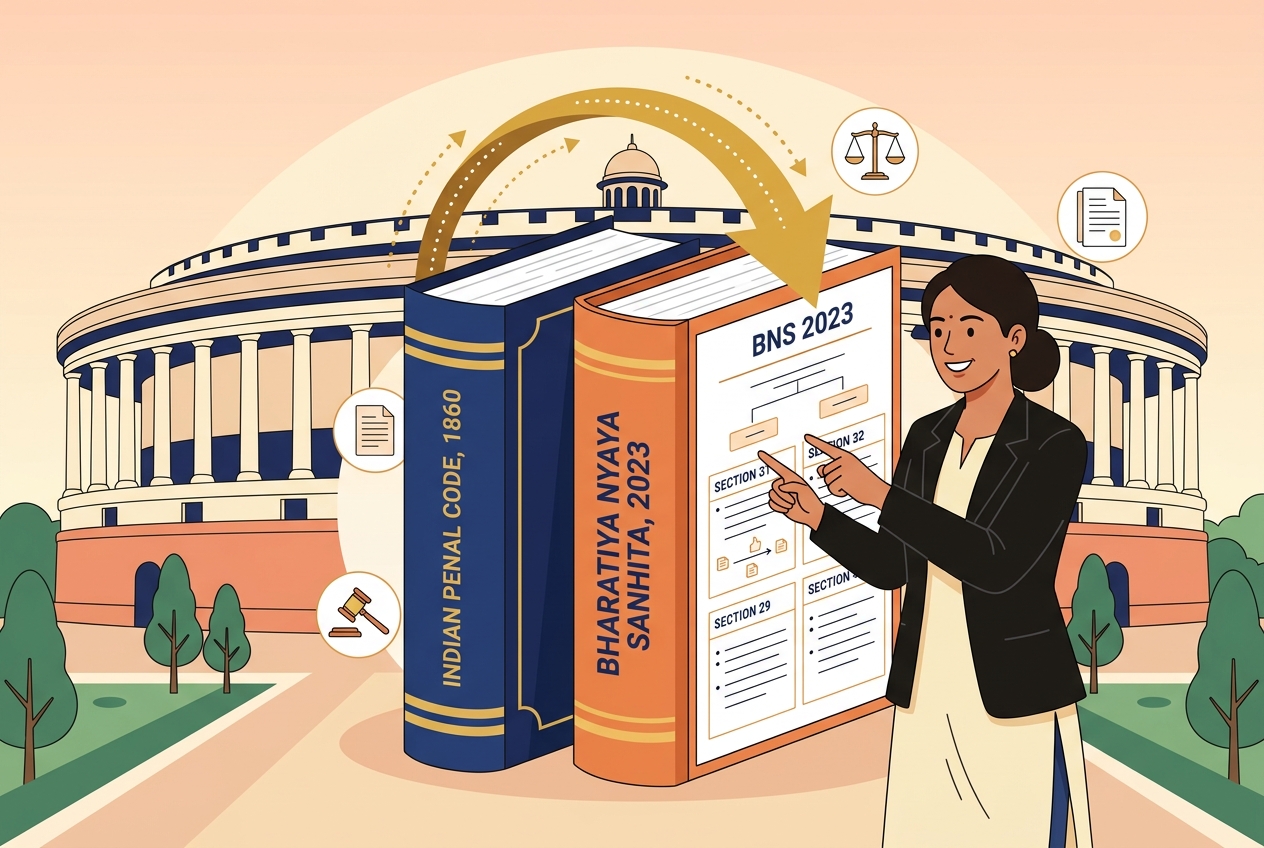
IPC Section 302 to BNS: What Changed?
IPC Section 302 (Murder) has been replaced by Section 101 of the Bharatiya Nyaya Sanhita (BNS), 2023, effective 1 July 2024. The punishment — death or imprisonment for life plus fine — remains identical. The BNS also introduces a new sub-category: murder by a group of five or more persons (mob lynching), which now mandates life imprisonment or death as the minimum sentence.
The Bharatiya Nyaya Sanhita: Why the IPC Was Replaced
On 1 July 2024, India's century-old Indian Penal Code, 1860 (IPC) was formally repealed and replaced by the Bharatiya Nyaya Sanhita (BNS), 2023. The stated objectives of the transition were to:
- Remove colonial-era language and restructure the criminal code around Indian constitutional values
- Rationalise and consolidate overlapping provisions (the IPC had 511 sections, many duplicative)
- Introduce new offences reflecting 21st-century realities — including organised crime, terrorism, and cybercrime
- Standardise sentencing across related offences
The transition affects not just the IPC but also the Code of Criminal Procedure (CrPC) — now the Bharatiya Nagarik Suraksha Sanhita (BNSS) — and the Indian Evidence Act — now the Bharatiya Sakshya Adhiniyam (BSA).
Key IPC to BNS Section Conversion Table
| Offence | IPC Section | BNS Section | Key Changes |
|---|---|---|---|
| Murder | 302 | 101 | New sub-clause: mob lynching (5+ persons) = mandatory life/death |
| Culpable Homicide | 304 | 105 | Substantially unchanged |
| Attempt to Murder | 307 | 109 | Substantially unchanged |
| Theft | 378–382 | 303–308 | Restructured into tiers; "snatching" now explicitly defined |
| Cheating | 415–420 | 316–318 | Consolidated; cyberfraud made an aggravated offence |
| Sedition | 124A | 152 | Renamed "acts endangering sovereignty"; scope narrowed |
| Criminal Conspiracy | 120A–120B | 61 | Definition unchanged; placed earlier in the code |
| Breach of Contract (Criminal) | 405–409 | 314–316 | Criminal breach of trust provisions largely retained |
| Defamation | 499–500 | 356 | Substantially unchanged; online defamation now covered |
Impact on Pending Cases Filed Under the IPC
This is the most practically important question for litigants and lawyers. The Ministry of Home Affairs clarified through notifications that:
- Cases filed (FIR or charge sheet) before 1 July 2024 under the IPC will continue under the IPC provisions — they are not retroactively converted to BNS sections.
- Cases arising from incidents on or after 1 July 2024 are filed and tried under BNS, even if the FIR was filed with an old IPC section number by error — courts have the power to correct this.
- The limitation periods under the new BNSS may differ from CrPC — lawyers handling transitional cases must check both codes for applicable timelines.
New Offences Introduced in the BNS with No IPC Equivalent
- Organised Crime (Section 111 BNS): A structured offence for organised criminal groups — previously handled under individual state laws (Maharashtra Control of Organised Crime Act, etc.). Now a central statute offence.
- Terrorism (Section 113 BNS): Previously under UAPA. BNS incorporates terrorism as a mainstream criminal offence, though UAPA remains in force as a special law.
- Petty Organised Crime (Section 112 BNS): Covers gang activities that don't meet the full threshold of Section 111 — pickpocketing rings, ATM fraud networks, etc.
- Hit-and-Run with Failure to Report (Section 106(2) BNS): A controversial new provision penalising drivers who flee the scene of an accident causing death with up to 10 years' imprisonment — significantly harsher than the IPC equivalent.
Implications for Commercial Contracts and Compliance
While the BNS primarily governs criminal law, it has important downstream effects on commercial agreements:
- Cheque bounce provisions (Section 138 NIA): Remain under the Negotiable Instruments Act — unchanged by BNS. However, the BNSS changes to criminal procedure affect cheque bounce trial timelines.
- Fraud clauses in contracts: Legal notice templates and force majeure clauses that cited "criminal breach of trust under IPC Section 405–409" should now reference "BNS Section 314–316."
- Employment agreements: Clauses referencing criminal misconduct and citing specific IPC sections must be updated to reference corresponding BNS sections to remain accurate.
How the BNS Affects Contract Drafting and Legal Notices
The transition from IPC to BNS has direct, practical implications for commercial lawyers and businesses drafting agreements, legal notices, and compliance documents:
- Legal notices for non-payment: Many standard Indian legal notice templates cite IPC Section 420 (cheating) and IPC Section 405 (criminal breach of trust) as alternative criminal remedies alongside civil claims. These must now reference BNS Section 318 and BNS Section 314 respectively for notices concerning conduct on or after 1 July 2024.
- Employment agreements — misconduct clauses: Agreements that list specific criminal offences (e.g., "conviction under IPC Section 302") as grounds for termination without notice should be updated to reference BNS sections — particularly for employees joining after 1 July 2024 whose conduct would be governed by the BNS.
- Force majeure and government action clauses: Some contracts reference "criminal prosecution under applicable Indian law." While this phrasing is broadly still valid, contracts specifically citing IPC schedules or sections in their definitions should be reviewed.
Transitional Period: Practical Guidance for Lawyers
The Ministry of Law and Justice and the Ministry of Home Affairs issued a series of clarifications in 2024 addressing transitional concerns:
- FIRs filed before 1 July 2024 citing IPC sections remain valid — courts will not reject them for non-conversion to BNS
- Charge sheets filed after 1 July 2024 for pre-1 July offences may cite either IPC sections or BNS equivalents — courts are directed to use good faith interpretation
- Legal practitioners appearing in cases filed before 1 July 2024 need not rewrite submissions — both codes operate concurrently for pending matters
- For lawyers drafting fresh plaints, petitions, or notice under Section 138 NIA (cheque bounce), the BNS sections should be cited for the criminal law aspects of any new action
The BNS and Technology-Related Offences
A significant improvement in the BNS over the IPC is the explicit inclusion of cyber-enabled offences within the main criminal code, rather than relying entirely on the Information Technology Act:
- Section 318 BNS (Cheating) now explicitly covers online fraud and digital impersonation as aggravated forms of cheating
- Section 356 BNS (Defamation) covers publication through electronic means
- Section 294 BNS (Obscene acts) extends to electronic publication of obscene material
The IT Act remains in force as a special law and its provisions — including Section 66C (identity theft), 66D (cheating by personation), and 67 (obscene material) — continue to apply. In cases of overlap, the special IT Act provisions typically prevail over the general BNS provisions under the principle of lex specialis.
Convert Any IPC Section to BNS Instantly
Use our free IPC to BNS Converter tool — search any section number and instantly see the corresponding BNS provision, punishment, and key changes.
Open IPC to BNS Converter →Quick Reference: Most-Used IPC to BNS Section Conversions
For everyday legal practice, the most frequently cited IPC sections and their BNS equivalents are: Section 302 IPC (Murder) → Section 101 BNS; Section 304 IPC (Culpable Homicide) → Section 105 BNS; Section 307 IPC (Attempt to Murder) → Section 109 BNS; Section 376 IPC (Rape) → Section 64 BNS (with significantly expanded definitions); Section 420 IPC (Cheating) → Section 318 BNS; Section 406 IPC (Criminal Breach of Trust) → Section 316 BNS; Section 499 IPC (Defamation) → Section 356 BNS; Section 124A IPC (Sedition) → Section 152 BNS (substantially narrowed). Use our free IPC to BNS Converter tool to search any section instantly.
Frequently Asked Questions
Are non-compete clauses valid in India?
Under Section 27 of the Indian Contract Act, 1872, any agreement that restrains anyone from exercising a lawful profession, trade, or business is void. This means post-employment non-competes are generally unenforceable in India. According to Section 10 of the Indian Contract Act 1872, agreements are enforceable only when executed with the free consent of parties competent to contract, for a lawful consideration, and with a lawful object.
What is the standard notice period in India?
Typically, notice periods range from 30 to 90 days. For employees on probation, it's often shorter (15-30 days). This is subject to the provisions of the Indian Contract Act 1872 and other applicable local regulations, which define the rights, obligations, and legal remedies available to the contracting parties. This is subject to the provisions of the Indian Contract Act 1872 and other applicable local regulations, which define the rights, obligations, and legal remedies available to the contracting parties.
Can an employer reduce my salary during the contract term?
Generally, no. A unilateral reduction in salary without a corresponding amendment signed by the employee can be challenged as a breach of contract. This is subject to the provisions of the Indian Contract Act 1872 and other applicable local regulations, which define the rights, obligations, and legal remedies available to the contracting parties.
Are electronic signatures legally valid in Indian contracts?
Yes. Under Section 10A of the Information Technology Act 2000, electronic contracts and digital signatures are legally recognized and enforceable. However, certain documents like negotiable instruments, power of attorney, trust deeds, and wills cannot be executed electronically.