Property Law • Tenancy Guide
Leave and License vs Rent Agreement: Complete Comparison (2026)
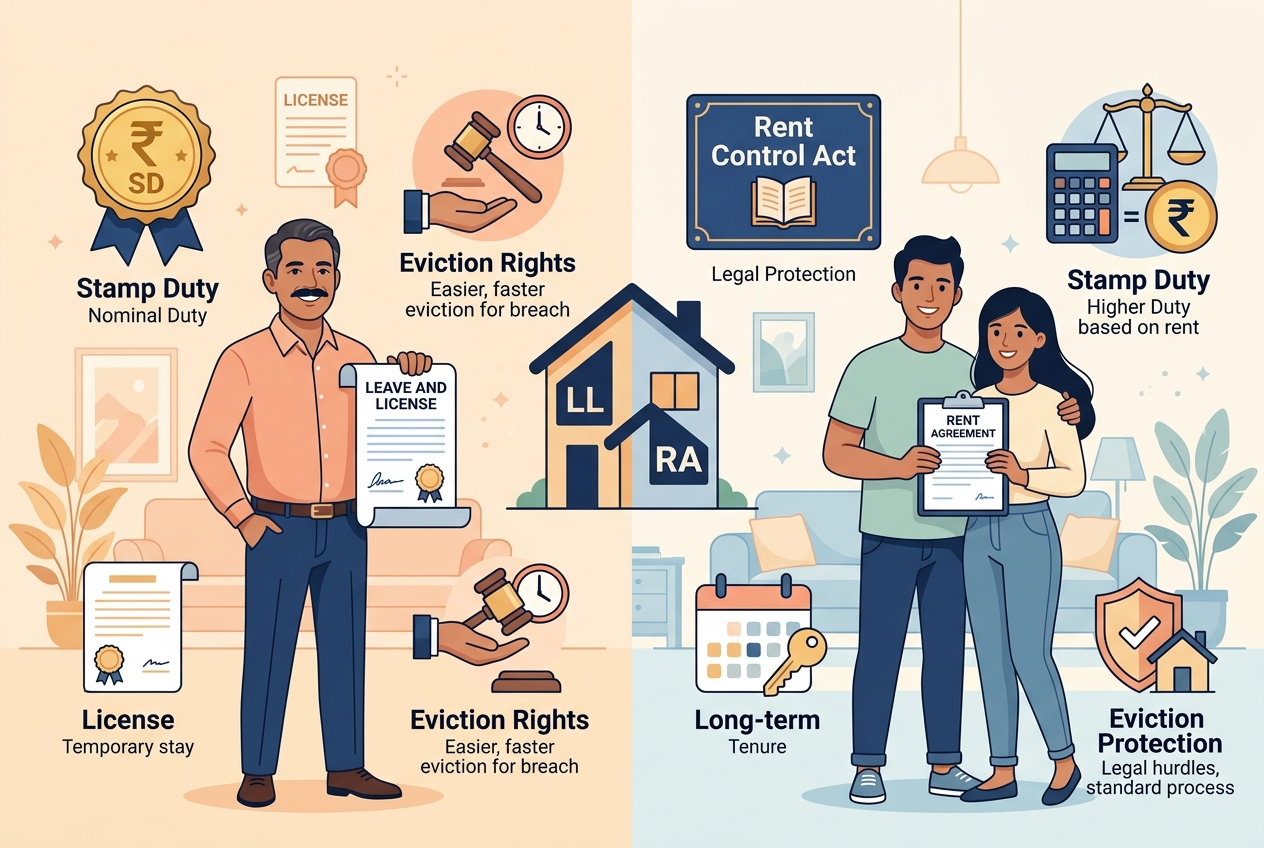
Summary: What Is the Difference Between Leave & License and a Rent Agreement?
In India, a Rent Agreement / Lease is governed by Section 105 of the Transfer of Property Act 1882 and creates a legal transfer of interest in the real estate, creating heritable possessory rights that make eviction subject to complex rent control litigation. A Leave and License Agreement is governed by Section 52 of the Indian Easements Act 1882 and grants only personal, non-transferable permission to occupy the premises without transferring legal possession. Landlords overwhelmingly prefer Leave and License because eviction is dramatically faster and licensee rights terminate automatically upon notice.
If you have ever rented a flat in Mumbai, Bengaluru, Pune, Delhi NCR, or Hyderabad, you have probably noticed that brokers and lawyers almost never title the contract a "Lease Agreement" or traditional "Rent Deed." Instead, they insist on executing a Leave and License Agreement for 11 months.
To a layperson, both documents look like contracts where an occupant pays money to live in someone else's house. But under Indian jurisprudence, the legal distinction between a Lease and a License is the difference between retaining total ownership control or accidentally entering a ten-year eviction lawsuit in civil court.
In this definitive guide, we analyze the two governing statutes — the Transfer of Property Act, 1882 and the Indian Easements Act, 1882 — and explain exactly which contract structure protects you best.
1. The Core Statutory Difference: Lease vs. License
Section 105, Transfer of Property Act 1882: The Lease
"A lease of immovable property is a transfer of a right to enjoy such property, made for a certain time, express or implied, or in perpetuity, in consideration of a price paid or promised..."
Legal Consequence: A lease creates an interest in rem (a legal right in the property itself). The tenant gains legal possession against the entire world, including the landlord, subject to the lease terms.
Section 52, Indian Easements Act 1882: The License
"Where one person grants to another... a right to do, or continue to do, in or upon the immovable property of the grantor, something which would, in the absence of such right, be unlawful, and such right does not amount to an easement or an interest in the property, the right is called a license."
Legal Consequence: A license creates an interest in personam (a personal right only). It gives zero proprietary interest. The legal possession remains with the owner/licensor; the occupier has mere permissive possession.
2. 12-Parameter Comparison Matrix
The table below provides a granular legal comparison across all functional aspects of property tenancy in India:
| Feature / Parameter | Leave and License Agreement | Rent Agreement / Lease Deed |
|---|---|---|
| Governing Statute | Indian Easements Act, 1882 (Section 52) | Transfer of Property Act, 1882 (Section 105) & State Rent Acts |
| Parties Defined | Licensor (Owner) & Licensee (Occupant) | Lessor (Landlord) & Lessee (Tenant) |
| Interest in Property | None. Purely personal permission to use premises. | Yes. Creates an estate and proprietary interest in the property. |
| Possession Status | Legal possession remains with Licensor; Licensee has "custody/use". | Exclusive legal possession is transferred to Lessee. |
| Eviction Process | Summary proceedings under Rent Control / Competent Authority (fast). | Full civil suit for possession; governed by protective Rent Control Acts (can take years). |
| Heritability | Not Heritable. Ends immediately upon death of either party. | Heritable. Rights transfer to tenant's legal heirs for remainder of lease term. |
| Sub-letting Rights | Strictly prohibited; license is personal to named licensee. | Permitted unless expressly prohibited in the lease contract. |
| Duration Standard | Typically 11 months (renewable by mutual consent). | Can be 1 year, 3 years, 99 years, or perpetual. |
| Revocability | Easily revocable by Licensor per notice clause. | Irrevocable except on established grounds of breach specified in TPA. |
| Maharashtra Mandate | Compulsory registration under Section 55 MRCA 1999. | Compulsory registration if >11 months under Registration Act 1908. |
| Security Deposit Cap | Mutually negotiable (typically 2 to 6 months' rent). | Model Tenancy Act caps residential deposits at 2 months' rent. |
| Court Jurisdiction | Competent Authority / Small Causes Court. | Civil Courts / Rent Control Tribunals. |
3. Why Landlords Overwhelmingly Insist on Leave and License
In India's post-independence history, traditional Rent Control Acts (such as the Bombay Rents Act) heavily favored tenants. Rents were frozen at "standard rent" levels from decades past, and eviction of tenants was virtually impossible even after lease expiry.
The Leave and License structure was pioneered as a legal safeguard to protect property owners:
- Summary Eviction under Section 24 (Maharashtra): Under Section 24 of the Maharashtra Rent Control Act, 1999, a landlord can approach a designated Competent Authority if a licensee refuses to vacate after term expiry. The Competent Authority can order immediate eviction and levy double the monthly license fee as damages for unauthorized overstay, bypassing civil court delays.
- No Adverse Possession: A licensee can never claim title to the property through adverse possession, because their occupation was by permissive license under Section 52.
- No Transfer of Tenancy: If a tenant passes away, their children cannot legally demand to inherit the license or continue living in the apartment at old rent rates.
Watch Out for "Exclusive Possession" Phrasing
The Supreme Court of India in Associated Hotels of India v. R.N. Kapoor (1959) ruled that whether a document is a lease or a license depends on the true intention of the parties, not merely the title written on top. If a contract labeled "Leave and License" grants "exclusive, quiet possession" to the occupant and restricts the owner from entering, courts may re-classify it as a Lease, stripping the landlord of quick eviction remedies!
Signing a Tenancy Agreement or Property License?
Run your draft contract through ContractShield AI. We scan for dangerous possession clauses, vague security deposit deductions, and lock-in period loopholes before you sign.
Review Your Tenancy Contract Free →4. When Should a Tenant Insist on a Lease Deed?
While landlords favor Leave and License, there are critical commercial situations where a Lease Agreement is mandatory for the tenant's security:
- Commercial & Retail Spaces: If you are opening a restaurant, showroom, or clinic and spending ₹20 Lakhs to ₹1 Crore on interior fit-outs, you cannot accept an 11-month license that the landlord can revoke with 30 days' notice. You need a registered 5-year or 9-year Lease with long lock-in protections.
- Startup Office Incubation: Growing companies investing in branding, infrastructure, and server installations require long-term operational certainty and fixed rent escalation percentages (e.g., 5% every year).
- Banking & Corporate Mortgages: Financial institutions often require a registered leasehold interest as collateral or proof of operational tenure when sanctioning business working capital loans.
5. Tax Obligations Landlords & Tenants Must Know (2026)
A. TDS under Section 194-IB (Residential Properties)
If you are an individual or HUF paying rent or license fee exceeding ₹50,000 per month, you must deduct 5% TDS from the payment under Section 194-IB of the Income Tax Act.
- No TAN is required; deduction is filed online using PAN and Form 26QC.
- Failure to deduct attracts interest penalties of 1% to 1.5% per month plus fines under Section 271H.
B. Standard Deduction for Landlords under Section 24(a)
Rental income received by the property owner (whether called rent or license fee) is taxed under "Income from House Property." Landlords are entitled to a flat 30% standard deduction for repairs and maintenance, regardless of actual expenses incurred, plus deduction of municipal taxes actually paid.
6. Key Clauses to Review in a Leave and License Agreement
Before signing an 11-month residential license, verify these non-negotiable protections:
- Lock-in Period Mutuality: If the tenant has a 6-month lock-in, ensure the landlord is equally bound not to terminate during those 6 months.
- Deposit Return Guarantee: The security deposit must be refunded simultaneously upon handover of keys. Any deduction for damages must be backed by original repair bills.
- Inspection Notice: The licensor can inspect the property only after giving at least 24 to 48 hours prior written notice during reasonable daytime hours.
- Maintenance Billing Clarity: Clear demarcation of who pays regular society maintenance versus major structural sinking fund charges.
Explore Free ContractShield Legal Templates
Download lawyer-drafted service agreements, NDAs, and commercial contracts complete with proper dispute resolution clauses.
View Legal Templates Catalog →Frequently Asked Questions
What is the primary legal difference between a lease and a leave and license agreement in India?
A Lease (governed by Section 105 of the Transfer of Property Act, 1882) transfers an interest in the immovable property to the tenant, creating possessory and heritable rights. A Leave and License agreement (governed by Section 52 of the Indian Easements Act, 1882) merely grants a personal, revocable permission to occupy the property without granting any legal interest in the real estate.
Why do landlords in India prefer Leave and License agreements over Lease deeds?
Landlords strongly prefer Leave and License agreements because they make eviction significantly easier. Under a license, the licensee never acquires legal tenancy or possessory rights. If a licensee overstays, they become an unlawful trespasser, and in states like Maharashtra, eviction can be summarily ordered by a Competent Authority without years of protracted civil court litigation.
Can a licensee sub-let the property to someone else?
No. Under Section 52 of the Indian Easements Act, a license is strictly personal to the licensee and cannot be assigned, transferred, or sub-licensed to any third party unless expressly permitted in writing by the licensor.
Is a Leave and License agreement heritable by the tenant's legal heirs?
No. A license automatically terminates upon the death of the licensee or licensor because it is a personal privilege. A lease, by contrast, creates a proprietary estate that passes to the tenant's legal heirs for the remainder of the lease term.
Is TDS applicable on rent paid under a Leave and License agreement?
Yes. Under Section 194-IB of the Income Tax Act, any individual or HUF paying rent or license fees exceeding ₹50,000 per month is legally required to deduct 5% TDS from the payment and remit it to the government using Form 26QC.