LLP vs Pvt Ltd Company: Which is Better for Your Startup? (2026)
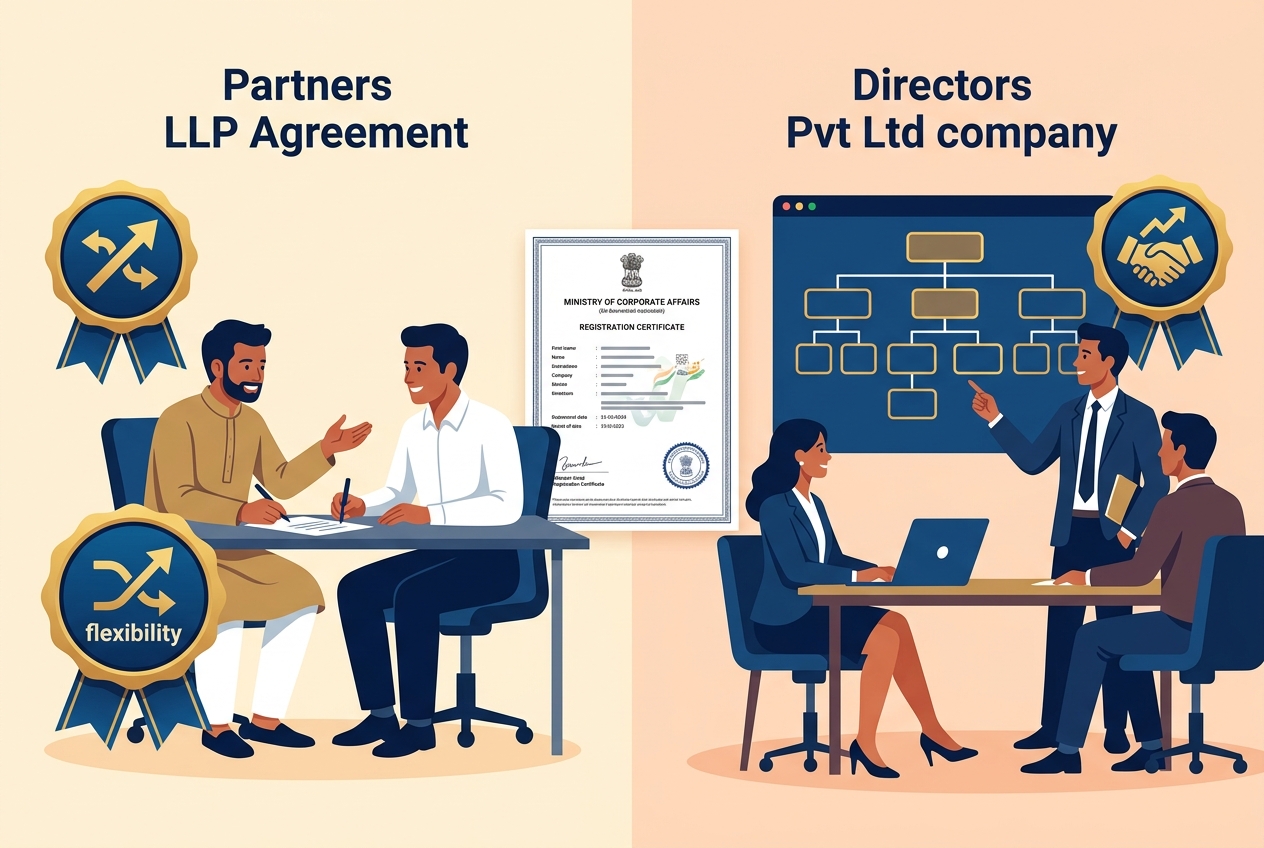
What is an Llp Vs Pvt Ltd Company?
An LLP agreement is a legal document registered under the Limited Liability Partnership Act 2008 that defines the capital contribution, profit-sharing, and management duties of partner members.
The wrong choice can cost you lakhs in taxes or compliance fees. Here's a quick breakdown to help you decide.
1. Comparison Table: At a Glance
| Feature | LLP | Pvt Ltd Company |
|---|---|---|
| Registration Cost | Low (₹5000 approx) | Medium (₹10,000+) |
| Compliance | Low (Annual Return only) | High (Board meetings, Audit mandatory) |
| Fundraising | Difficult (VCs prefer shares) | Easy (Issue equity shares) |
| Tax Rate | Flat 30% | 25% (for turnover < ₹400Cr) |
| Audit | Only if turnover > ₹40L | Mandatory every year |
2. Why Choose LLP?
- Lower Compliance Cost: No need for mandatory board meetings or statutory audit (unless turnover exceeds ₹40 Lakhs or contribution exceeds ₹25 Lakhs).
- Flexible Agreement: The LLP Agreement defines the roles and profit-sharing ratio, offering more flexibility than rigid company laws.
- No Dividend Distribution Tax (DDT): Profits can be withdrawn by partners without paying DDT.
3. Why Choose Pvt Ltd?
- Investor Friendly: VCs and Angel Investors invest in exchange for equity shares. LLPs cannot issue shares, making them unattractive for high-growth startups.
- Separate Legal Entity: Directors have limited liability. Personal assets are protected in case of business losses (mostly true for LLPs too, but Pvt Ltd has stronger perception).
- ESOPs: Can issue stock options to attract top talent. LLPs cannot grant ESOPs.
Frequently Asked Questions (FAQ)
Can I convert my LLP to Pvt Ltd later?
Yes, but the process is cumbersome, time-consuming, and expensive. It involves transferring assets and re-registering. It's better to start as Pvt Ltd if you foresee funding soon.
Is a One Person Company (OPC) better?
OPC is good for solo founders but has restrictions on turnover. If you cross ₹2 Crore turnover, you must convert to Pvt Ltd anyway.
Detailed Comparison: LLP vs. Private Limited Company in India
The choice between an LLP and a Private Limited Company affects taxation, governance, investor eligibility, compliance burden, and operational flexibility. Here is a comprehensive comparison:
| Factor | LLP | Private Limited Company |
|---|---|---|
| Governing Law | LLP Act, 2008 | Companies Act, 2013 |
| Minimum Partners/Directors | 2 designated partners | 2 directors, 2 shareholders |
| Minimum Capital | No minimum | No minimum (post-2015 amendment) |
| Tax on Business Income | 30% flat (no surcharge below Rs 1 cr) | 22% (new tax regime) or 25–30% (old regime) |
| Dividend Distribution Tax | No DDT — profit share to partners is tax-free | Dividends taxed in shareholders' hands at applicable slab rate |
| Venture Capital Eligible? | No — VCs cannot invest in LLPs | Yes — standard investment vehicle |
| ESOP for Employees | Not possible under current law | Yes — governed by SEBI/Companies Act |
| Annual Compliance | Form 11 (annual return) + Form 8 (Statement of Accounts) | AOC-4 (financials) + MGT-7 (annual return) + multiple board meeting compliance items |
| Statutory Audit | Required only if turnover exceeds Rs 40 lakh or contribution exceeds Rs 25 lakh | Mandatory for all Pvt Ltd companies regardless of turnover |
| Conversion to Pvt Ltd? | Possible but complex — requires RoC approval and tax implications | Can convert to Public Limited for IPO |
When an LLP Agreement Is More Suitable
An LLP structure is the right choice when:
- You are in a professional services business — law firms, consulting, accounting, architecture, and similar professions where partners contribute expertise rather than capital.
- You don't plan to raise institutional capital — foreign VCs and most domestic VCs cannot invest in LLPs. If funding from institutional investors is part of your plan, incorporate as a Private Limited company from day one.
- Tax efficiency on profit distributions is a priority — profit shares received by LLP partners are exempt from tax in their hands (avoiding double taxation). Dividends from Pvt Ltd companies are taxable at the shareholder's slab rate.
- You want lower annual compliance costs — LLP compliance is significantly simpler and cheaper than Private Limited company compliance, especially for small professional firms.
Key LLP Agreement Clauses to Include
A well-drafted LLP Agreement must cover:
- Capital Contribution: Amount each designated partner contributes, whether in cash, kind, or expertise. Specify the contribution schedule and what happens if a partner fails to contribute.
- Profit Sharing Ratio: The ratio in which profits (and losses) are shared. Can differ from capital contribution ratio. Should specify treatment of reserves and retained earnings.
- Management and Voting: Which decisions require unanimous consent vs. majority vote. Admission of new partners requires unanimous consent unless the agreement provides otherwise.
- Retirement and Exit: How a partner exits, the valuation mechanism for their interest, and the notice period required.
- Dispute Resolution: Arbitration is strongly preferred for LLP partner disputes over court litigation, which can be expensive and prolonged.
Don't Sign Blindly. Protect Yourself.
Templates are just a start. Use Contract Shield's AI to scan your contract for hidden risks, unfair clauses, and Indian legal compliance issues — in 60 seconds.
Analyze Your Contract Free →