Dispute Resolution
The Mediation Act 2023: Key Features & Benefits Explained
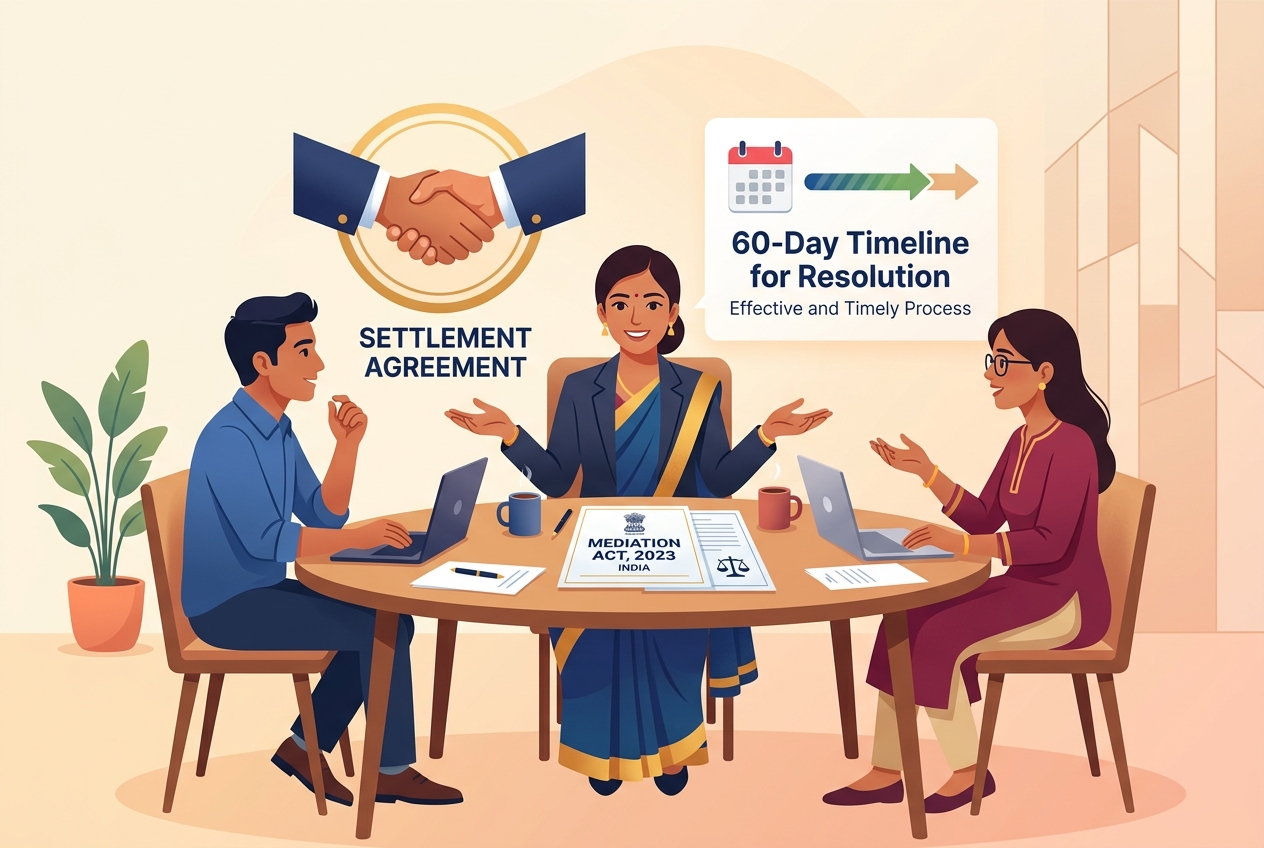
What is an The Mediation Act 2023?
The Mediation Act 2023 provides a formal legal framework for promoting and enforcing mediated settlements in commercial and civil disputes in India, introducing pre-litigation mediation.
The Mediation Act, 2023 is a game-changer for dispute resolution in India. For the first time, India has a comprehensive law that gives mediation—a process where a neutral third party helps disputants find a solution—statutory backing and legal enforceability.
For businesses, this means faster, cheaper, and more amicable dispute resolution.
What is New in the Mediation Act 2023?
1. Enforceability of Settlements
This is the biggest win. Earlier, a mediated settlement agreement was just a contract. Now, under Section 27, a Mediated Settlement Agreement (MSA) is enforceable as if it were a judgment or decree of a court. This gives it teeth.
2. Pre-Litigation Mediation
Parties are encouraged to attempt mediation before approaching a court or tribunal. While initially voluntary, the central government may make this mandatory for certain commercial disputes in the future.
3. Strict Timelines
Mediation must be completed within 120 days, extendable by another 60 days. This prevents the process from dragging on like court cases.
Why Should Businesses Choose Mediation?
- Cost-Effective: No hefty prolonged legal fees. Mediation creates value by finding creative solutions rather than just winning/losing arguments.
- Confidentiality: Unlike court cases which are public, mediation proceedings are strictly confidential. Your business secrets stay safe.
- Preserves Relationships: Court battles destroy relationships. Mediation preserves them, which is crucial for long-term vendors or partners.
- Control: In court, a judge decides your fate. In mediation, you control the outcome. You can walk away if you don't like the settlement.
The Process Explained
- Agreement to Mediate: Can be a clause in your contract or a separate agreement after a dispute arises.
- Appointment: Parties select a mediator (or ask an institution to appoint one).
- Joint Sessions: Mediator facilitates discussion to understand core issues.
- Private Caucuses: Mediator meets parties separately to explore confidential settlement options.
- Settlement Agreement: If resolved, terms are written down and signed. This becomes binding.
Online Mediation
The Act specifically recognizes online mediation, making it easier for parties in different cities to resolve disputes via video conferencing without travel costs.
Don't Sign Blindly. Protect Yourself.
Templates are just a start. Use Contract Shield's AI to scan your contract for hidden risks, unfair clauses, and Indian legal compliance issues — in 60 seconds.
Analyze Your Contract Free →Frequently Asked Questions
Is pre-litigation mediation mandatory under the 2023 Act?
The Act initially proposes voluntary pre-litigation mediation, but the Central Government may notify mandatory pre-litigation mediation for specific types of civil or commercial disputes in the future. Such clauses are subject to the Arbitration and Conciliation Act 1996, which provides the legal framework for domestic arbitration, enforcement of awards, and judicial intervention limits in commercial disputes.
Is a mediated settlement agreement binding?
Yes. A Mediated Settlement Agreement (MSA) resulting from mediation is final and binding on the parties and is enforceable as if it were a judgment or decree of a court. According to Section 10 of the Indian Contract Act 1872, agreements are enforceable only when executed with the free consent of parties competent to contract, for a lawful consideration, and with a lawful object.
What is the timeline for completing mediation?
The Act mandates that the mediation process must be completed within 120 days, which can be extended by another 60 days with the mutual consent of the parties (Total 180 days). Compliance must align with the Digital Personal Data Protection (DPDP) Act 2023, which imposes obligations on data fiduciaries to obtain explicit consent and implement robust security safeguards for processing personal data.
Can we challenge a mediated settlement in court?
Yes, but on very limited grounds such as fraud, corruption, impersonation, or where the subject matter was not fit for mediation. This ensures the finality of the settlement. Such clauses are subject to the Arbitration and Conciliation Act 1996, which provides the legal framework for domestic arbitration, enforcement of awards, and judicial intervention limits in commercial disputes.
Are electronic signatures legally valid in Indian contracts?
Yes. Under Section 10A of the Information Technology Act 2000, electronic contracts and digital signatures are legally recognized and enforceable. However, certain documents like negotiable instruments, power of attorney, trust deeds, and wills cannot be executed electronically.