Guides
MSME Late Payment Interest Rate: Rules & Calculation
Understand the statutory interest rates, 45-day payment timelines, Section 43B(h) tax impact, and Samadhaan filing process under the MSMED Act 2006.
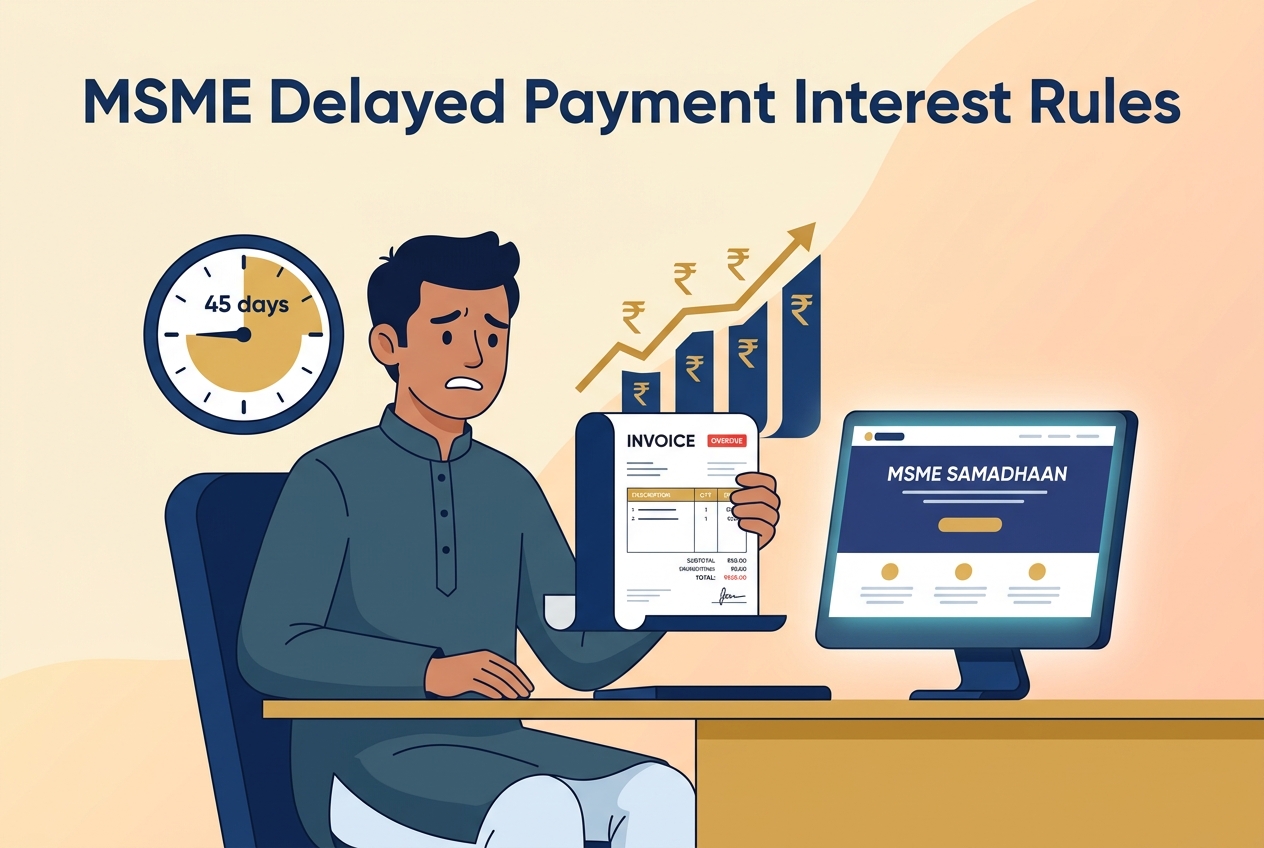
What is the MSME Delayed Payment Interest Rate?
Under Section 16 of the MSMED Act 2006, buyers who delay payment to registered MSME suppliers beyond 45 days must pay compound interest with monthly rests at three times the RBI bank rate from the appointed day.
MSME Delayed Payment Rules: The Complete 2026 Guide
India's MSME sector — comprising over 63 million enterprises — is chronically affected by delayed payments from larger buyers. The Micro, Small and Medium Enterprises Development (MSMED) Act, 2006 provides a powerful legal framework to address this. Despite being 18 years old, most MSME suppliers and many buyers remain unaware of the exact provisions and penalties.
Who Counts as an MSME? (2026 Classification)
| Category | Investment in Plant & Machinery | Annual Turnover |
|---|---|---|
| Micro Enterprise | Up to ₹1 crore | Up to ₹5 crore |
| Small Enterprise | Up to ₹10 crore | Up to ₹50 crore |
| Medium Enterprise | Up to ₹50 crore | Up to ₹250 crore |
To claim protection under the MSMED Act, the enterprise must be registered on the Udyam Registration Portal. Udyam registration is free, takes under 10 minutes, and requires only the Aadhaar number of the owner. Without Udyam registration, the protections under the Act are not available.
The Payment Timeline Rules Under MSMED Act
- With written agreement: Payment must be made within the agreed period — but the agreement cannot specify a period exceeding 45 days from the date of delivery of goods or services (Section 15, MSMED Act). Any agreed period beyond 45 days is void.
- Without written agreement: Payment must be made within 15 days of delivery (Section 15).
- Both cases — interest trigger: If payment is delayed beyond the agreed period (max 45 days) or 15 days (if no agreement), compound interest accrues automatically at 3× the RBI bank rate.
How to Calculate MSME Delayed Payment Interest
The interest rate is: 3 × RBI Bank Rate. As of June 2026, the RBI Bank Rate is 6.5%, making the effective MSME interest rate approximately 19.5% per annum, compounded monthly.
Example: Invoice of ₹5,00,000 | Due Date: 1 March 2026 | Payment Date: 1 June 2026
Delay: 92 days (~3 months)
Interest = ₹5,00,000 × 19.5% × (92/365) = ₹24,616
MSME Samadhaan: How to File a Delayed Payment Complaint
The Ministry of MSME operates the MSME Samadhaan portal (samadhaan.msme.gov.in) for filing delayed payment complaints. The process is:
- Register on the Samadhaan portal using your Udyam Registration number
- File an application with invoice copies, delivery proof, and correspondence
- The case is referred to the MSME Facilitation Council of the relevant state
- Conciliation is attempted first (45-day window)
- If conciliation fails, the Council acts as an arbitrator and issues an award
- The award is enforceable as a decree of a civil court
Section 43B(h) of the Income Tax Act: The Buyer's Incentive to Pay
A significant 2023 amendment to the Income Tax Act added Section 43B(h), which provides that any payment due to an MSME supplier that remains unpaid beyond the period specified in the MSMED Act is not deductible as a business expense in the buyer's accounts for that financial year. Payment is only deductible when actually made — not when accrued. This creates a powerful incentive for corporate buyers to pay MSME vendors on time, as delayed payment results in a higher taxable profit for the buyer company.
Calculate MSME Delayed Payment Interest
Use our free MSME Interest Calculator to instantly compute the interest owed to you under the MSMED Act — including the compounded amount from the actual delay.
Calculate MSME Interest →Frequently Asked Questions
How long should an NDA last in India?
Typically, NDAs for commercial discussions last 2-5 years. However, for trade secrets like source code or manufacturing formulas, they can be perpetual. This is subject to the provisions of the Indian Contract Act 1872 and other applicable local regulations, which define the rights, obligations, and legal remedies available to the contracting parties.
Are NDAs enforceable without payment (consideration)?
Yes, in the context of business sharing, the mutual exchange of information or the opportunity to discuss a partnership is considered valid consideration under the Indian Contract Act. Specifically, Section 17 of the Copyright Act 1957 stipulates that the creator is the first owner of copyright unless there is a written contract assigning these rights to another entity, such as an employer or client.
What is the maximum credit period allowed for MSME payments in India?
Under Section 15 of the MSMED Act 2006, payments to registered MSMEs must be made within 45 days if there is a written agreement, or within 15 days in the absence of an agreement. Buyers who delay payment face compounding interest penalties at three times the RBI bank rate.