Employment Law • Worker Rights
Notice Period Rules in India: Can an Employer Force You to Serve It? (2026)
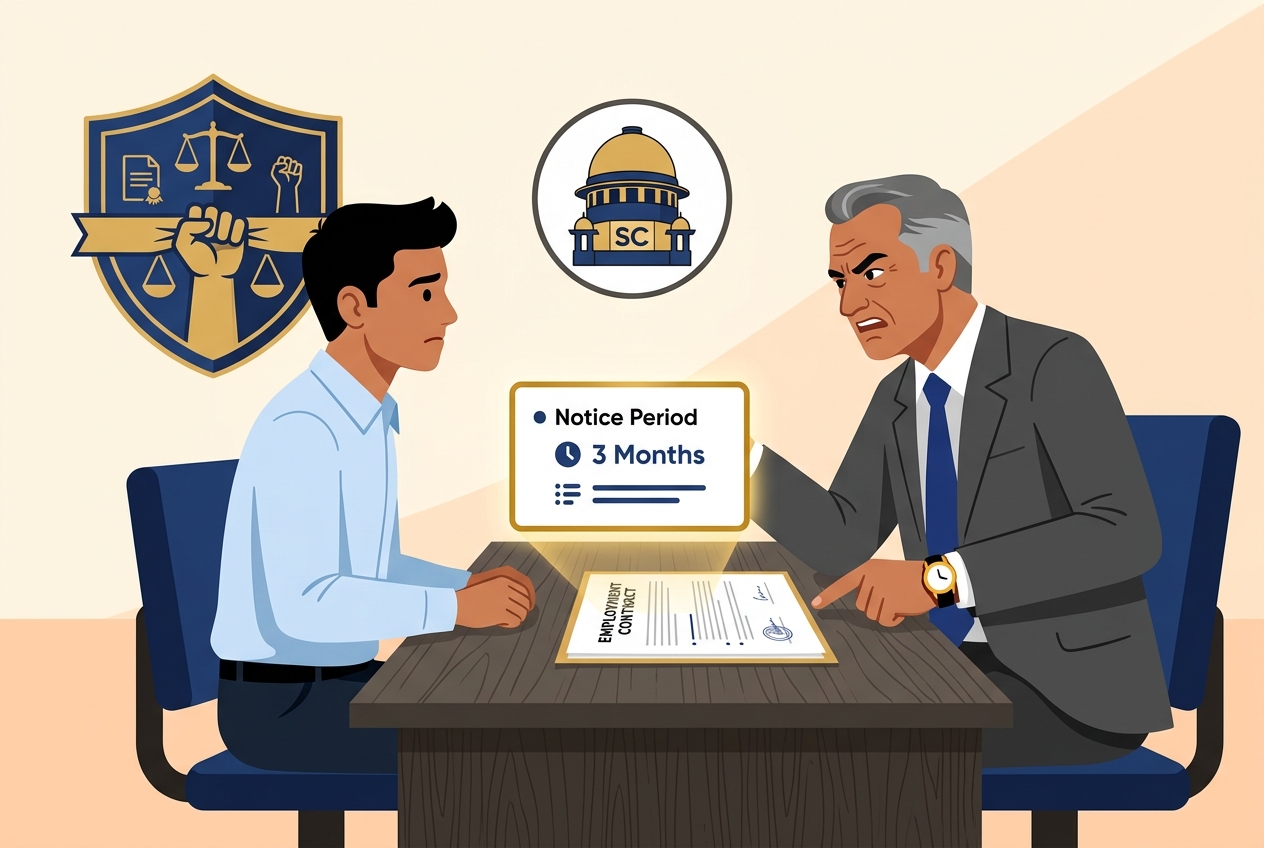
Summary: Can an Employer Legally Force You to Serve a Notice Period in India?
No employer in India can legally or physically force you to serve a notice period. Under Section 14 of the Specific Relief Act, 1963, Indian courts cannot grant specific performance of contracts involving personal service. Furthermore, Article 23 of the Constitution strictly prohibits forced labour. An employer cannot reject a resignation (except during active disciplinary fraud inquiries) or obtain an injunction to stop you from resigning. The employer's sole legal remedy for an unserved notice period is claiming contractual notice pay in lieu of notice.
In India's corporate and IT landscape — particularly across tech giants like TCS, Infosys, Wipro, HCL, and Accenture — the 90-day (3-month) notice period has become an infamous industry bottleneck.
When an employee secures a dream offer with a 30-day joining window, their current HR often issues severe warnings: "Your resignation is rejected. You must serve all 90 days. We will not allow a buyout. If you leave early, you will be terminated with cause, blacklisted on NASSCOM NSR, and denied your relieving letter."
Does an employer possess the legal authority to hold you captive for 90 days? What does Indian statutory law actually say?
In this definitive 2026 legal analysis, we examine the Specific Relief Act, 1963, state Shops & Commercial Establishments Acts, notice period buyout calculations, leave adjustments, and how to successfully exit without sacrificing your career documents.
1. The Statutory Shield: Why Forced Service Is Illegal in India
When an HR manager claims they will "force" you to serve your notice period, they are asserting a legal power that does not exist under Indian law.
Section 14, Specific Relief Act 1963: Contracts Not Specifically Enforceable
Section 14(c) explicitly provides that "a contract which is so dependent on the personal qualifications of the parties that the court cannot enforce specific performance of its material terms" cannot be specifically enforced.
An employment relationship is purely personal. A court can never order an employee into specific performance of service. No judge, police officer, or government authority can compel you to log into your work laptop or report to an office.
Article 23 of the Constitution: Prohibition of Forced Labour
Under Article 23(1) of the Constitution of India, compelling an individual to perform work against their will — even under color of a signed employment agreement — constitutes unlawful forced labour ("begar").
2. Can an Employer "Reject" Your Resignation?
In the private sector, resignation is a unilateral legal act. It is the exercise of a contracting party's right to determine the contract.
- In Dr. Prabha Atri v. State of U.P. (2003 1 SCC 701), the Supreme Court held that resignation is an unequivocal expression of intention to renounce service.
- Once an employee formally conveys their resignation in writing and tenders the contractual notice or notice pay, the employment contract stands determined upon the expiry of that period.
- The Only Exception: An employer can withhold acceptance of resignation only if the employee is currently facing formal, documented disciplinary proceedings for criminal fraud, financial embezzlement, or serious data theft. In the absence of a pending charge sheet, an employer cannot "refuse" a resignation.
3. Notice Period Buyout: How Is It Calculated?
Most standard employment contracts contain a mutual clause allowing separation via notice or salary in lieu thereof:
| Component | Standard Contract Term | Employee Impact |
|---|---|---|
| Buyout Formula | (Monthly Salary ÷ 30) × Unserved Days | Calculates exact compensation owed for leaving early. |
| Salary Base | "Basic Salary" vs. "Gross Emoluments" | If the clause specifies "Basic Salary", the buyout is far cheaper than if it demands Gross CTC. |
| Who Can Buy Out? | Mutual option vs. Employer discretion | If the clause gives the employee the unilateral option to pay notice pay, the employer cannot refuse the buyout. |
Practical Example:
- Basic Salary: ₹45,000 / month | Total Notice Period: 90 Days
- Employee serves 30 days and wishes to buy out remaining 60 days.
- Daily Basic = ₹45,000 ÷ 30 = ₹1,500
- Buyout Amount = ₹1,500 × 60 days = ₹90,000
Calculate Your Notice Period Buyout Instantly
Use ContractShield's Notice Period Buyout Calculator to compute your exact payout, leave offsets, and last working day in seconds.
Launch Notice Period Calculator Free →4. Can You Take Leaves During Your Notice Period?
One of the most frequent workplace dilemmas is managing sick leave and earned leave during notice periods:
Sick Leave, Casual Leave & Privilege Leave
1. Sick Leave (SL): If you fall genuinely ill during your notice period, an employer cannot legally force you to work. Provide a registered medical practitioner's certificate. However, company HR policies frequently state that unserved days due to sick leave will extend your Last Working Day (LWD) by the corresponding number of days.
2. Casual Leave (CL): Casual leaves are generally disallowed or frozen during notice periods.
3. Privilege Leave / Earned Leave (PL / EL): Under state Shops and Commercial Establishments Acts, accrued privilege leaves are statutory earned benefits. You have the legal right to either: (a) adjust accumulated leaves to reduce your physical notice period days; or (b) receive cash encashment in your Full & Final (FnF) settlement.
5. Can an Employer Legally Withhold Your Relieving Letter?
Withholding service documentation is the primary coercive pressure tactic used by HR departments when employees insist on an early exit.
Withholding Service Certificates Is Unlawful
An Experience Certificate is an objective statement of fact confirming that an individual was employed between two dates. Withholding it to coerce monetary concessions constitutes an unlawful restraint of trade and an infringement on the citizen's constitutional right to earn a livelihood under Article 19(1)(g).
If an employee has tendered contractual notice pay in lieu of notice and completed asset handovers, the employer has zero lawful ground to withhold relieving documents.
6. Step-by-Step Playbook for Negotiating an Early Release
- Check Your Appointment Letter First: Verify whether the notice buyout clause says "at the sole discretion of the company" or "either party may terminate by giving 30 days' notice or salary in lieu thereof."
- Document Formal Knowledge Transfer (KT): The main legitimate business objection to an early release is incomplete handover. Create a comprehensive handover document, schedule daily KT sessions with team members, and obtain signed KT sign-offs. Once your manager signs off that KT is 100% complete, HR loses its factual defense.
- Offer Notice Buyout in Writing: State clearly: "In accordance with Clause [X] of my offer letter, I hereby offer to buy out the remaining 45 days of my notice period through deduction in my Full and Final settlement."
- Utilize Alternative BGV Proofs: If HR remains obstinate, rest assured that background verification (BGV) agencies and top employers accept alternative proofs of clean separation: offer letter, monthly payslips, Form 16, bank statements showing salary credits, resignation email trail, and your EPFO UAN service record.
Review Your Job Offer & Resignation Terms
Upload your employment agreement to ContractShield AI. We check notice buyout terms, garden leave provisions, and non-compete enforceability instantly.
Explore Employment Contracts Catalog →Frequently Asked Questions
Can an employer in India legally force you to serve your notice period?
No. Under Section 14 of the Specific Relief Act, 1963, contracts for personal service cannot be specifically enforced by courts. In addition, Article 23 of the Constitution of India prohibits forced labour. An employer cannot obtain an injunction or police order forcing you to work. The employer's only legal recourse for an unserved notice period is claiming monetary compensation for the unserved notice period as specified in the contract.
Can an employer reject an employee's resignation in India?
In the private sector, an employer generally cannot reject a resignation unless the employee is under active internal disciplinary investigation for grave misconduct or embezzlement. Resignation is a unilateral legal right of an employee to terminate their employment contract by giving requisite notice or offering notice pay.
How is a notice period buyout calculated in India?
Notice period buyout is calculated as: (Applicable Monthly Salary ÷ 30) × Number of Unserved Notice Days. Whether 'salary' means Basic Salary or Gross CTC depends strictly on the wording of your appointment letter (such as 'basic salary in lieu of notice' vs 'gross emoluments').
Can I adjust my earned leaves (EL / PL) against my notice period?
Yes, subject to company policy and mutual agreement. Under state Shops and Commercial Establishments Acts, accrued privilege/earned leaves represent earned statutory rest. Many companies allow employees to offset accumulated leave balances to advance their Last Working Day (LWD).
What can I do if my employer refuses to give me a relieving letter?
If an employer unlawfully withholds your relieving letter and experience certificate after notice buyout or handover, you should: (1) preserve all resignation emails, payslips, and handover sign-offs; (2) send a formal legal demand notice citing restraint of livelihood; and (3) file a complaint with the regional Labour Commissioner under the state Shops and Establishments Act.