Employment Law • Indian Contract Act
Section 27 Indian Contract Act: Are Non-Compete Clauses Legal in India?
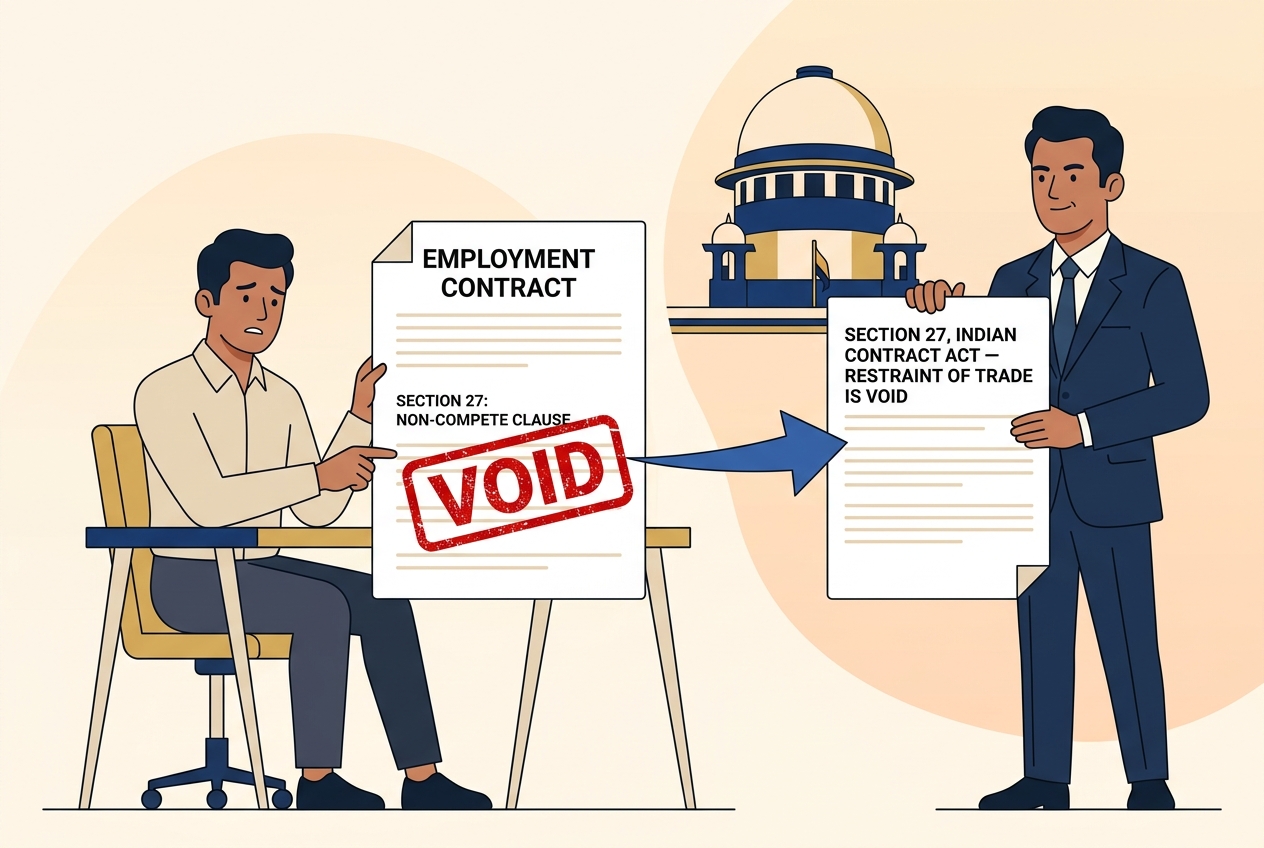
Summary: Are Post-Employment Non-Compete Agreements Enforceable in India?
Under Section 27 of the Indian Contract Act, 1872, any contractual provision restraining an individual from exercising a lawful profession, trade, or business after leaving employment is void ab initio. Unlike the United States or the UK, Indian law does not recognize the "doctrine of reasonableness" for post-termination restrictions. As reaffirmed by the Supreme Court in Percept D'Mark v. Zaheer Khan, courts will not enforce post-service non-compete covenants. However, non-competes during active employment, reasonable non-solicitation clauses, and confidentiality obligations remain fully enforceable.
If you have ever signed an offer letter, founders' agreement, or employment contract in India, you have almost certainly encountered a clause that reads something like this:
"For a period of twelve (12) months following the termination of employment for any reason, the Employee shall not directly or indirectly engage in, work for, consult with, or advise any business entity that competes with the Company anywhere within India."
To an employee or founder, this clause sounds terrifying. It threatens that leaving your employer means you cannot earn a livelihood in your domain of expertise for an entire year.
The reality? In the eyes of Indian law, this post-employment restriction is completely worthless and legally void.
In this definitive analysis, we unpack the precise statutory mechanics of Section 27 of the Indian Contract Act, 1872, contrast Indian law with Anglo-American jurisprudence, examine pivotal Supreme Court rulings, and clarify what employers can — and cannot — legally protect.
1. The Exact Statutory Wording of Section 27
Section 27 of the Indian Contract Act is one of the most uncompromising, unambiguous statutory provisions in global commercial law:
Section 27: Agreement in Restraint of Trade, Void
"Every agreement by which any one is restrained from exercising a lawful profession, trade or business of any kind, is to that extent void."
Exception 1 — Saving of agreement not to carry on business of which good-will is sold: One who sells the goodwill of a business may agree with the buyer to refrain from carrying on a similar business, within specified local limits, so long as the buyer, or any person deriving title to the goodwill from him, carries on a like business therein, provided that such limits appear to the Court reasonable, regard being had to the nature of the business.
Notice three critical legal truths that flow directly from this statutory text:
- "To that extent void": The law does not necessarily void the entire employment contract; it invalidates the specific restrictive covenant that restrains your trade or employment.
- No Mention of "Reasonableness" in Employment: The word "reasonable" appears only in Exception 1 regarding the sale of commercial goodwill (e.g., when you sell an entire restaurant business and agree not to open an identical restaurant next door). It does not apply to master-servant or employer-employee relationships!
- Fundamental Right Alignment: Section 27 directly reinforces Article 19(1)(g) of the Constitution of India, which guarantees every citizen the right to practice any trade or profession. Statutory contracts cannot supersede constitutional liberties.
2. India vs. US & UK: Why the "Doctrine of Reasonableness" Does Not Apply
Many multinational corporations (MNCs) headquartered in California, Delaware, or London paste standard US/UK employment covenants into their Indian employment templates. This is a fatal legal error.
| Jurisdiction | Legal Standard for Post-Employment Non-Competes | Can Courts Blue-Pencil / Modify? |
|---|---|---|
| United States (Common Law) | Enforceable if "reasonable" in geographic scope, duration (e.g., 6–12 months), and legitimate business interest (though FTC issued non-compete bans subject to federal litigation). | Yes. Courts frequently reform or "blue-pencil" unreasonable terms to make them enforceable. |
| United Kingdom | Enforceable if the employer proves a legitimate proprietary interest and the restraint is no wider than reasonably necessary. | Courts may sever offending words if the core clause remains coherent. |
| India (Section 27 ICA) | Strict Statutory Prohibition. Post-employment restraints are void ab initio. The reasonableness of duration or geography is completely irrelevant. | No. Courts cannot rewrite or dilute void restraints to salvage them for employers. |
3. The Crucial Distinction: "During" vs. "Post" Employment
Indian jurisprudence draws a clear, impenetrable line between covenants that operate during employment versus those that attempt to govern life after employment.
Negative Covenants During Active Employment
As long as you are actively employed and drawing a salary, an employer can demand your exclusive services. Clauses prohibiting moonlighting, side freelancing, or working with a rival while employed are completely valid under Indian law. The Supreme Court established this in Niranjan Shankar Golikari (1967).
Negative Covenants After Employment Terminates
The moment the employment relationship ends — whether via resignation, mutual separation, or layoff — the employee's freedom of trade is restored unconditionally. Any restriction barring you from joining a rival, starting a competing firm, or servicing the industry is void under Section 27.
4. Landmark Supreme Court Judgments That Settled the Law
A. Superintendence Company of India (P) Ltd. v. Krishan Murgai (1980)
The Supreme Court of India directly addressed whether a post-service restriction of 2 years within a specified territory was enforceable if "reasonable." The 3-judge bench emphatically ruled:
"A contract in restraint of trade is one by which a party restricts his future liberty to carry on his trade, profession or business... Section 27 does not admit of any exception other than the sale of goodwill. A negative covenant that operates after the cessation of employment is void, and the question of whether it was reasonable or not does not arise."
B. Percept D'Mark (India) Pvt. Ltd. v. Zaheer Khan (2006)
In this high-profile sports and media law dispute, cricket icon Zaheer Khan entered into an agency contract with Percept D'Mark that contained a "right of first refusal" preventing him from signing with any other promotional agency post-term without matching terms.
The Supreme Court held that the right of first refusal was a post-contractual restrictive covenant in restraint of trade under Section 27 and declared it wholly void and unenforceable. The court confirmed that no injunction could be granted against an individual seeking to contract elsewhere after the expiry of the agreement.
Is Your Contract Trying to Trap You?
Upload your employment agreement, NDA, or consulting contract to ContractShield. Our AI instantly highlights void Section 27 covenants, illegal penalties, and hidden liability traps.
Scan Your Contract for Free →5. What CAN Employers Legally Protect? (The 3 Enforceable Shields)
If non-compete clauses are void, how do corporations legally safeguard their investments, client relationships, and intellectual property in India? They rely on three recognized legal mechanisms:
1. Non-Disclosure & Trade Secret Protection
An NDA is not a restraint of trade — it is the protection of proprietary property. Even though an ex-employee is free to work for a competitor, they cannot disclose, transfer, or exploit the previous employer's proprietary source code, confidential pricing models, customer databases, or trade secrets. Indian courts routinely grant injunctions against the misuse of stolen intellectual property under the law of breach of confidence.
2. Non-Solicitation Clauses (Clients & Employees)
Unlike non-competes, reasonable non-solicitation clauses have been upheld by Indian High Courts (e.g., Delhi High Court in Wipro Ltd. v. Beckman Coulter International S.A.).
- Client Non-Solicit: Barring an ex-employee from actively soliciting or pitching to specific existing clients they managed for a period of 1 to 2 years.
- Employee Non-Poach: Restraining an ex-executive from poaching their former team members to join their new venture.
3. Garden Leave Arrangements
If an employer considers an executive so strategically vital that their immediate departure to a rival would cause irreparable commercial harm, the only enforceable route under Indian law is Garden Leave.
During garden leave, the employee remains formally on the payroll, receives 100% of their base compensation and contractual benefits, but is instructed not to report to the office or interact with clients. Because the employment contract is still alive, the negative covenant operates during employment and is legally enforceable.
6. Founder & Shareholder Agreements: When Non-Competes Actually Work
There is one critical commercial context where non-compete covenants are regularly upheld in India: Shareholder Agreements (SHA) and Business Acquisitions.
Under Exception 1 to Section 27 and Sections 36 and 54 of the Indian Partnership Act, 1932:
- When a founder sells their equity or business goodwill to an acquiring company or investor for substantial financial consideration, an agreement restricting the seller from immediately founding an identical competing startup within a specified geographic radius for 2 to 3 years is valid and legally enforceable.
- The justification is commercial fairness: a buyer who pays crores of rupees for the "goodwill" of a brand cannot have that value instantly destroyed by the seller setting up shop across the street the following Monday.
Need a Legally Sound NDA or Service Agreement?
Browse our verified legal templates crafted specifically for Indian corporate and contract law compliance.
Review Our NDA Guidelines →Frequently Asked Questions
Is a non-compete clause enforceable after resignation in India?
No. Under Section 27 of the Indian Contract Act, 1872, every agreement restraining anyone from exercising a lawful profession, trade, or business is void ab initio. The Supreme Court of India in Percept D'Mark v. Zaheer Khan held that the doctrine of restraint of trade applies to all post-employment restrictive covenants, and reasonableness tests cannot validate them.
Are non-compete clauses valid during the term of active employment?
Yes. Negative covenants operating strictly during the subsistence of the employment contract (such as exclusivity, anti-moonlighting, and devotion of working hours) are valid and enforceable, as affirmed in Niranjan Shankar Golikari v. Century Spinning.
What are the statutory exceptions to Section 27 of the Indian Contract Act?
The only statutory exception within Section 27 itself is the sale of goodwill: a person who sells the goodwill of a business may agree to refrain from carrying on a similar business within specified local limits, provided the limits appear reasonable to the court. Other statutory exceptions exist under Sections 11, 36, and 54 of the Indian Partnership Act, 1932.
Can an employer enforce a non-solicitation clause in India?
Yes, to a limited extent. Reasonable non-solicitation covenants (restraining former employees from actively poaching existing clients or staff for typically 1 to 2 years) have been upheld by Indian High Courts provided they do not completely prohibit the individual from practicing their profession.
What is garden leave and is it legal in India?
Garden leave is an arrangement where an employee serves their notice period away from the workplace while remaining on the employer's payroll and receiving full salary. Because the employment contract remains active, negative covenants preventing competitive work during this period are legally enforceable in India.