Software Licensing Agreements Guide: EULA, SaaS & Perpetual Models
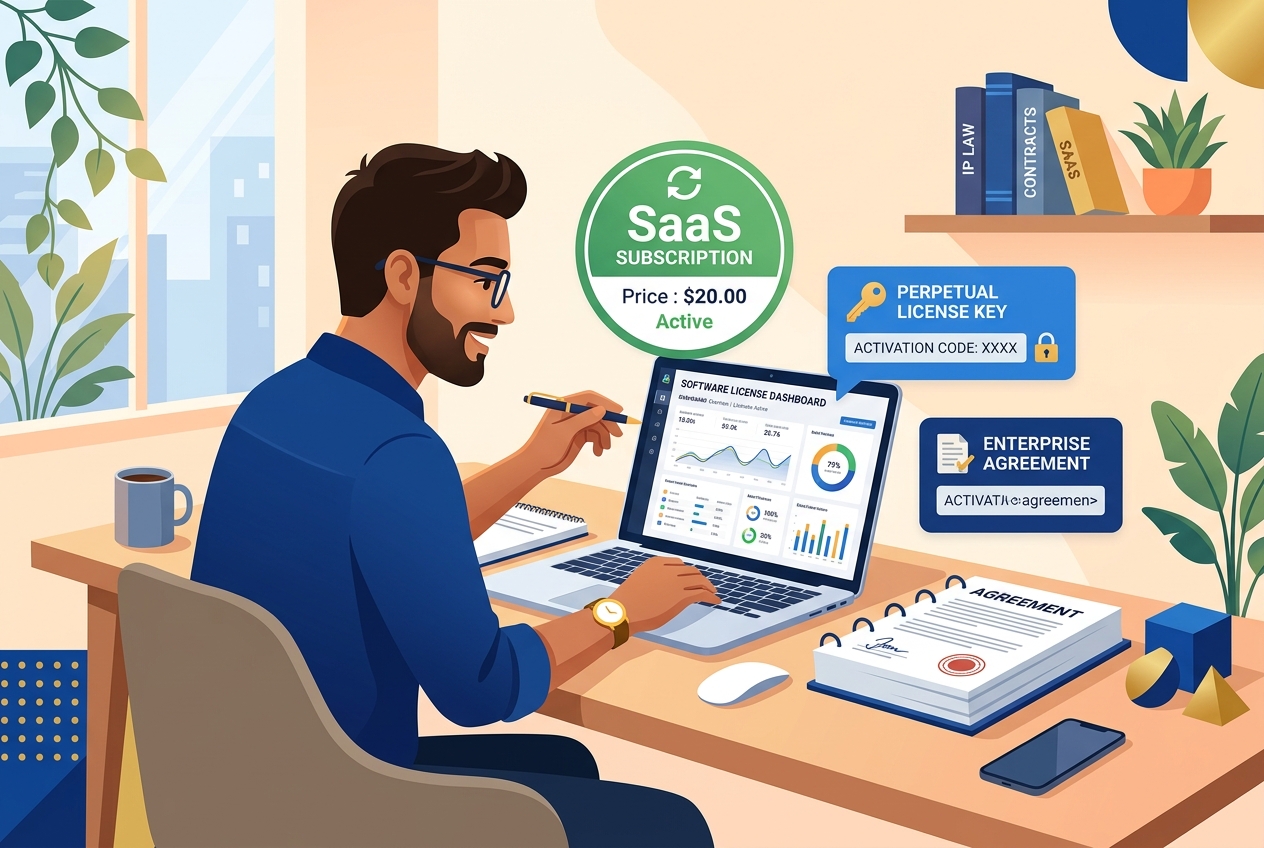
What is an Software Licensing Agreements?
A software licensing agreement is a legal contract where the software creator grants a license to use their proprietary code, specifying restrictions, user limits, and warranties.
Choosing the wrong license model can be disastrous. Give away too many rights, and users might resell your code. Too restrictive, and enterprise clients won't buy. This guide breaks down the three main models: EULA, SaaS, and Perpetual Licenses.
1. End User License Agreement (EULA)
This is the standard "click-wrap" agreement for downloadable software (desktop apps, mobile apps, games).
- Key Feature: Non-exclusive, non-transferable right to install and use the software on a specific device.
- Restrictions: Explicitly prohibits reverse engineering, decompiling, or modifying the code.
- Liability: Includes strong disclaimers (e.g., "Software provided AS IS") to limit liability for bugs or data loss.
2. SaaS Agreement (Software as a Service)
For cloud-based software (like Slack, Salesforce, or Contract Shield), users don't install anything—they just access it.
- Key Feature: Subscription-based access to a hosted service. No copy of the software is given to the user.
- Service Level Agreement (SLA): Guarantees uptime (e.g., 99.9%) and support response times.
- Data Privacy: Crucial clauses on who owns the user data and how it is processed (GDPR/DPDP compliance).
3. Perpetual License
The traditional model where the user pays a one-time fee to use a specific version of the software forever.
- Pros: High upfront revenue.
- Cons: No recurring revenue. Users may stick to old versions and refuse to pay for updates (Maintenance & Support contracts usually sold separately).
- Use Case: Enterprise on-premise software, industrial control systems.
Critical Clauses for Every Software License
- Grant of License: Be specific. Is it per user, per device, or per site? Is it revocable?
- Intellectual Property Rights (IPR): Explicitly state that you retain all ownership, title, and interest in the software.
- Restrictions on Use: No copying, no sub-licensing, no reverse engineering.
- Warranty Disclaimer: Limit your liability for damages. Do not guarantee that the software is "error-free."
- Termination: Define what happens when the user stops paying or breaches the terms (e.g., immediate revocation of access).
Frequently Asked Questions (FAQ)
Can I use open source code in my commercial software?
Be careful. "Copyleft" licenses (like GPL) require you to release your own source code if you use their components. Permissive licenses (like MIT, Apache) are safer for proprietary software.
Do I need an EULA for a mobile app?
Yes. Apple and Google Play stores require you to have an EULA or Terms of Use. Without it, you rely on their default terms, which may not protect you enough.
What happens if my software has a bug that causes data loss?
If your agreement has a strong "Limitation of Liability" clause, your damages are usually capped at the amount the user paid you (or a fixed sum). Without this clause, you could be sued for millions.
Don't Sign Blindly. Protect Yourself.
Templates are just a start. Use Contract Shield's AI to scan your contract for hidden risks, unfair clauses, and Indian legal compliance issues — in 60 seconds.
Analyze Your Contract Free →