Term Sheet vs Shareholders Agreement (SHA): Don't Sign Without Reading
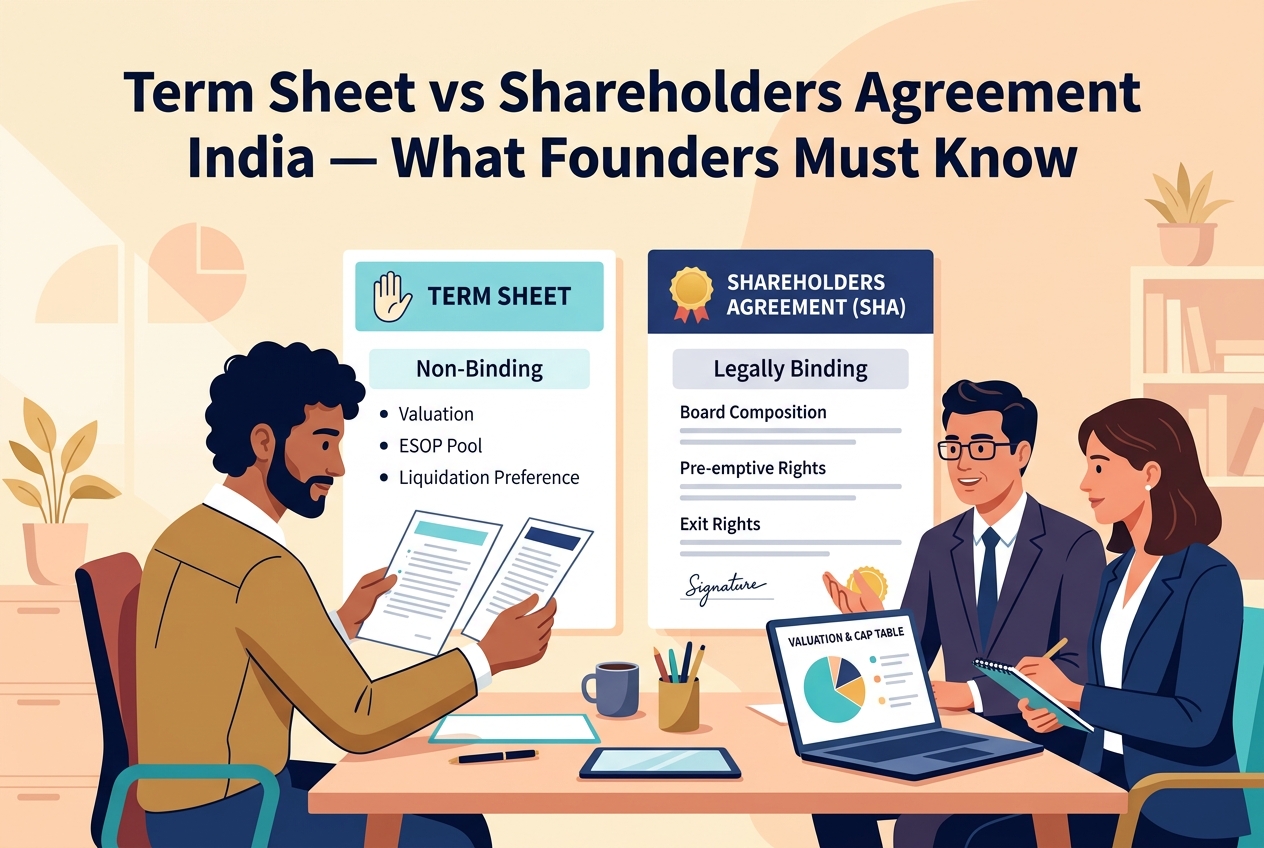
What is an Term Sheet Vs Shareholders Agreement (Sha)?
A term sheet is a preliminary document outlining investment terms, which is later formalized into binding share subscription and shareholder agreements (SSHA).
Knowing the difference can save you from giving up too much control or equity too early.
1. The Term Sheet: The First Step
A Term Sheet is a bullet-point document outlining the material terms and conditions of a potential investment. It serves as a blueprint for the lawyers to draft the final agreements.
- Binding Clauses: Confidentiality, Exclusivity (No-Shop), and Governing Law.
- Non-Binding Clauses: Valuation, Investment Amount, Board Seats, Liquidation Preference.
2. Shareholders Agreement (SHA): The Final Deal
The SHA regulates the relationship between the company, the founders, and the investors. It details rights, obligations, and exit mechanics.
- Right of First Refusal (ROFR): If a founder wants to sell shares, existing investors get first dibs.
- Tag-Along Rights: If majority shareholders sell, minority shareholders can join the deal.
- Drag-Along Rights: Majority shareholders can force minority shareholders to sell during an exit.
- Anti-Dilution: Protects investors if the company raises funds at a lower valuation in the future.
3. Share Subscription Agreement (SSA)
While SHA defines relationship, SSA is purely about the issuance of shares. It records the payment of money and allotment of shares.
4. Common Pitfalls for Founders
- Ignoring "participating" liquidation preference: Investors get their money back PLUS a share of the remaining, reducing founder returns.
- Veto Rights: Giving investors veto power over day-to-day operational decisions instead of just strategic ones.
- Founder Vesting: Not negotiating fair vesting terms for their own shares (reverse vesting).
Frequently Asked Questions (FAQ)
Can an investor back out after signing a Term Sheet?
Yes. Since the investment clause is non-binding, investors can withdraw during due diligence if they find red flags.
Do I need a lawyer for a Term Sheet?
Highly recommended. Terms agreed here are hard to renegotiate later in the SHA. Get a lawyer or use AI to analyze the risks first.
Key Provisions in a Term Sheet (Negotiating Guide)
A term sheet for an Indian startup funding round typically includes these critical provisions, each of which will be carried forward into the SHA:
Valuation and Dilution
The pre-money valuation determines your dilution. If you raise Rs 1 crore at a Rs 4 crore pre-money valuation, investors get 20% (Rs 1 cr / Rs 5 cr post-money). Always calculate the fully-diluted cap table — including all issued shares, warrants, convertible notes, and your ESOP pool — before agreeing to a valuation.
Most Indian term sheets include a post-money ESOP pool top-up — investors insist the ESOP pool is created before the investment, causing additional founder dilution. If the term sheet shows a 10% ESOP pool to be created, negotiate for it to be created after the investment to minimize founder dilution.
Anti-Dilution Protection
Anti-dilution provisions protect investors if the company raises a future round at a lower valuation (a "down round"). Two types:
- Full Ratchet — The most aggressive. Investors' price per share drops to the new, lower price. Extremely founder-unfriendly. Rare in Indian market but appears in distressed situations.
- Weighted Average (Broad-Based) — The standard. Adjusts the conversion price based on the size of the down round. Protects investors proportionally without catastrophic founder dilution. This is market standard in Indian VC term sheets.
Liquidation Preference
Specifies who gets paid first (and how much) if the company is sold or liquidated. The standard in Indian VC deals is 1x non-participating liquidation preference:
- 1x preference: Investors get back their invested amount first before founders share in proceeds.
- Participating: After getting their 1x back, investors also participate in remaining proceeds alongside founders. This double-dips — avoid if possible.
- Non-participating (standard): Investors choose between their 1x preference OR converting to equity and participating. They cannot do both.
Example: You raise Rs 5 cr. The company sells for Rs 8 cr. With 1x non-participating preference, investors choose: take Rs 5 cr (their 1x) and founders get Rs 3 cr, OR convert to equity and share proceeds proportionally.
Critical Differences: Term Sheet vs. SHA
| Aspect | Term Sheet | Shareholders' Agreement (SHA) |
|---|---|---|
| Legal status | Mostly non-binding (except exclusivity and confidentiality) | Fully legally binding on all parties |
| Length | 2–10 pages | 40–150+ pages |
| Negotiation stage | Commercial terms: valuation, dilution, key rights | Every legal detail: exact definitions, drag-along mechanics, information rights carve-outs |
| When signed | After initial pitch and investor interest | After due diligence, before money wires |
| Can be renegotiated? | Yes — term sheets are negotiating documents | Only by written amendment with all parties' consent |
SHA Clauses Founders Should Push Back On
- Full ratchet anti-dilution: Insist on broad-based weighted average instead. Full ratchet in a down round can wipe out founder equity entirely.
- Participating liquidation preference: Insist on non-participating. Participating preference means investors double-dip on exit proceeds.
- Drag-along at low thresholds: Investors should be able to drag founders in a sale only if a supermajority (75%+) of investors approve AND the price exceeds a minimum return threshold.
- Veto on operational decisions: Investors' consent rights should cover major transactions (acquisitions, asset sales, large capex) — not day-to-day operational decisions like key hires or product roadmap changes.
- Broad information rights: Monthly financials are reasonable. Weekly operational updates are not. Negotiate the frequency and format of information rights in the SHA.
Don't Sign Blindly. Protect Yourself.
Templates are just a start. Use Contract Shield's AI to scan your contract for hidden risks, unfair clauses, and Indian legal compliance issues — in 60 seconds.
Analyze Your Contract Free →