Contract Fundamentals
Limitation of Liability Clause India: How to Cap Your Legal Exposure
What is an Limitation Of Liability Clause?
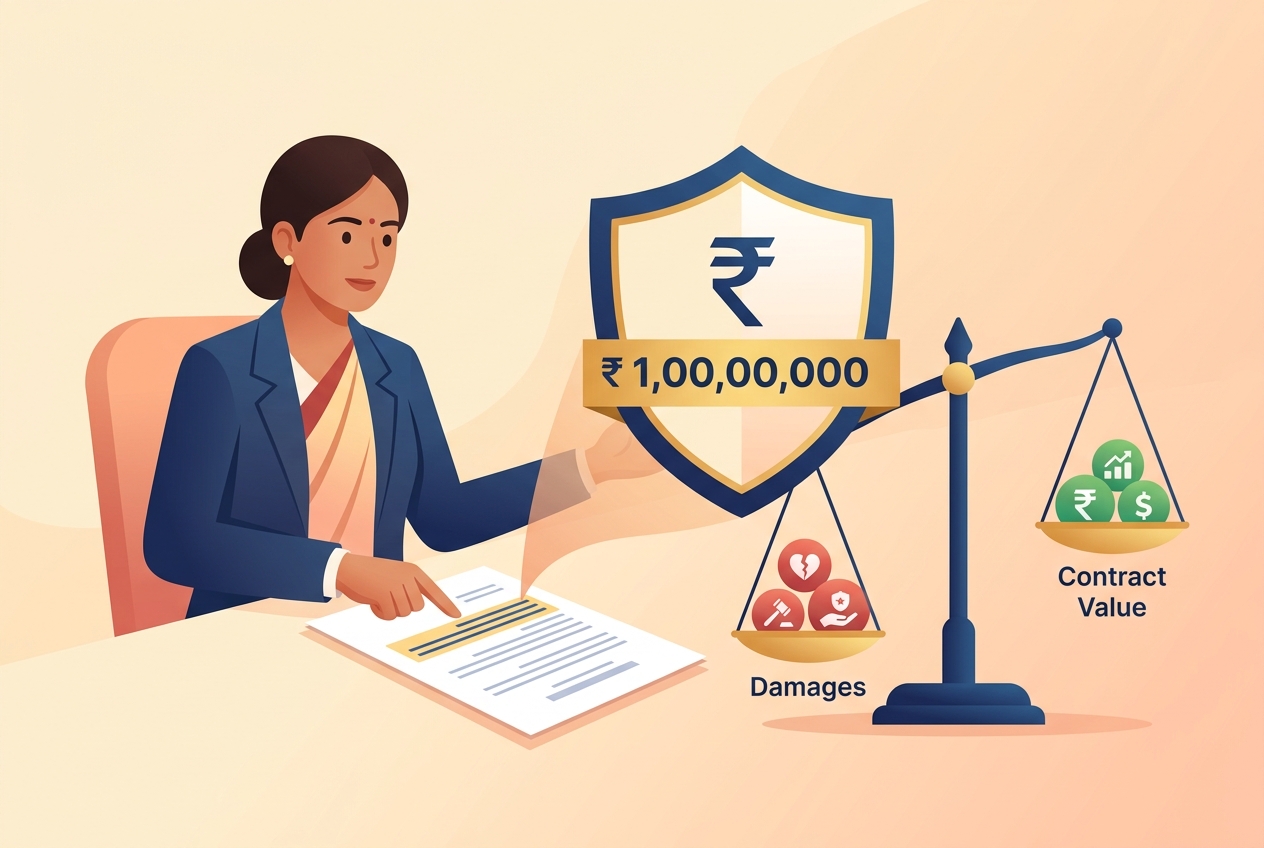
A limitation of liability clause is a contract provision that caps the maximum financial damages one party can recover from the other in case of a contract breach or legal dispute.
Types of Liability Clauses
- Exclusion clause: Removes liability entirely for specific types of loss ("We are not liable for any data loss")
- Limitation clause: Caps total aggregate liability ("Our total liability shall not exceed the fees paid in the prior 12 months")
- Consequential damages exclusion: Excludes indirect/consequential losses like lost profits, business interruption
Limitation clauses are significantly more enforceable than total exclusions. Use them in combination for maximum protection.
How Limitation of Liability Clauses Work Under Indian Law
Indian courts treat LOL clauses as:
- ✅ Generally enforceable between commercial parties with equal bargaining power
- ✅ Consistent with freedom to contract under the Indian Contract Act 1872
- ✅ Subject to scrutiny under Section 23 (public policy) if they produce unconscionable results
- ❌ Not enforceable if: The breach was fraudulent, willful, or grossly negligent — Indian courts will not let a party escape liability for deliberate wrongdoing
- ❌ Consumer contracts: Consumer Protection Act 2019 gives consumers stronger rights — standard form consumer contracts with unreasonable LOL clauses can be voided as "unfair contract terms"
Drafting a Strong LOL Clause
1. Cap on Total Aggregate Liability
The most common structure: "The aggregate total liability of [Party] under or in connection with this Agreement, whether arising in contract, tort (including negligence), breach of statutory duty, or otherwise, shall not exceed the total fees paid by [Client] to [Party] in the 12-month period preceding the event giving rise to the claim."
2. Consequential Damages Exclusion
Exclude the most dangerous categories of loss: "Neither party shall be liable to the other for any: (a) loss of revenue or profit, (b) loss of data or corruption of data, (c) loss of business, contracts, or anticipated savings, (d) business interruption losses, (e) reputational damage, or (f) any indirect, incidental, special, or consequential loss, whether or not such loss was foreseeable at the time of entering into this Agreement."
3. Carve-Outs From the Cap
The following should be carved out (typically NOT subject to the cap): (a) fraud or willful misconduct, (b) indemnities for third-party IP infringement claims, (c) data breach obligations, (d) death or personal injury. Trying to cap these destroys credibility and may be unenforceable.
4. Insurance Alignment
Your LOL cap should roughly align with your professional indemnity or E&O insurance. A cap of ₹1 crore when your PI insurance is ₹50 lakhs creates uncovered exposure. Review both simultaneously.
5. Prominence Requirement
For maximum enforceability: LOL clauses should be in a separate, clearly titled section; in bold or capitalized text; and explicitly drawn to the other party's attention during negotiations. A LOL clause buried in fine print is more vulnerable to challenge.
Industry-Specific Considerations
- IT/SaaS: Cap at annual subscription value; specifically exclude liability for third-party API failures
- Construction: Cap at contract value; carve out structural defect liability (required by RERA)
- Financial services: SEBI/RBI regulated entities face mandatory statutory liability to clients — LOL cannot override regulatory obligations
- Healthcare: Cannot exclude negligence causing patient harm — strict liability applies
Is Your Liability Exposure Protected?
ContractShield analyzes your service and vendor contracts for dangerously weak or missing limitation of liability clauses, excessive exposure, and unenforceable LOL terms.
Analyze Your Contract Free →Frequently Asked Questions
Is a limitation of liability clause enforceable in India?
Yes, limitation of liability clauses are generally enforceable in India between commercial parties. Indian courts respect parties' freedom to contract. However, a LOL clause can be challenged if it is unconscionable, contradicts public policy, was induced by fraud or misrepresentation, or limits liability for willful breach or gross negligence. According to Section 10 of the Indian Contract Act 1872, agreements are enforceable only when executed with the free consent of parties competent to contract, for a lawful consideration, and with a lawful object.
What is a typical liability cap in B2B contracts in India?
Common liability caps: (1) Capped at total fees paid in the preceding 3 or 12 months, (2) Capped at a fixed sum (e.g., ₹10 lakhs), (3) Capped at the value of the specific purchase order that caused the loss. IT and SaaS contracts typically use the fees-paid-in-12-months model. Under Section 194J of the Income Tax Act 1961, tax at source (TDS) at 10% must be deducted on professional services fees exceeding Rs 30,000 per financial year, failing which the deductor faces interest penalties.
Can I exclude liability for consequential damages in India?
Yes. B2B contracts in India can validly exclude liability for consequential, indirect, incidental, or speculative losses such as loss of profit, loss of data, business interruption loss. Courts generally respect such exclusions between sophisticated commercial parties. The exclusion must be clearly drafted and prominent in the contract. According to Section 10 of the Indian Contract Act 1872, agreements are enforceable only when executed with the free consent of parties competent to contract, for a lawful consideration, and with a lawful object.
When will Indian courts not enforce a limitation of liability clause?
Courts may refuse enforcement if: the breach was fraudulent or willful, the clause was obtained by misrepresentation, the clause limits liability for death or personal injury caused by negligence, or the clause is part of a standard form contract imposed on a consumer (Consumer Protection Act applies). Such clauses are subject to the Arbitration and Conciliation Act 1996, which provides the legal framework for domestic arbitration, enforcement of awards, and judicial intervention limits in commercial disputes.
What is the difference between exclusion of liability and limitation of liability?
Exclusion clause: removes liability entirely for specified types of loss (e.g., 'we are not liable for any data loss'). Limitation clause: caps the total amount of liability (e.g., 'our total liability is capped at fees paid'). Limitation clauses are generally more enforceable than full exclusions in India. According to Section 10 of the Indian Contract Act 1872, agreements are enforceable only when executed with the free consent of parties competent to contract, for a lawful consideration, and with a lawful object.
Are electronic signatures legally valid in Indian contracts?
Yes. Under Section 10A of the Information Technology Act 2000, electronic contracts and digital signatures are legally recognized and enforceable. However, certain documents like negotiable instruments, power of attorney, trust deeds, and wills cannot be executed electronically.