Contract Law
Breach of Contract in India: Types, Remedies & Legal Action
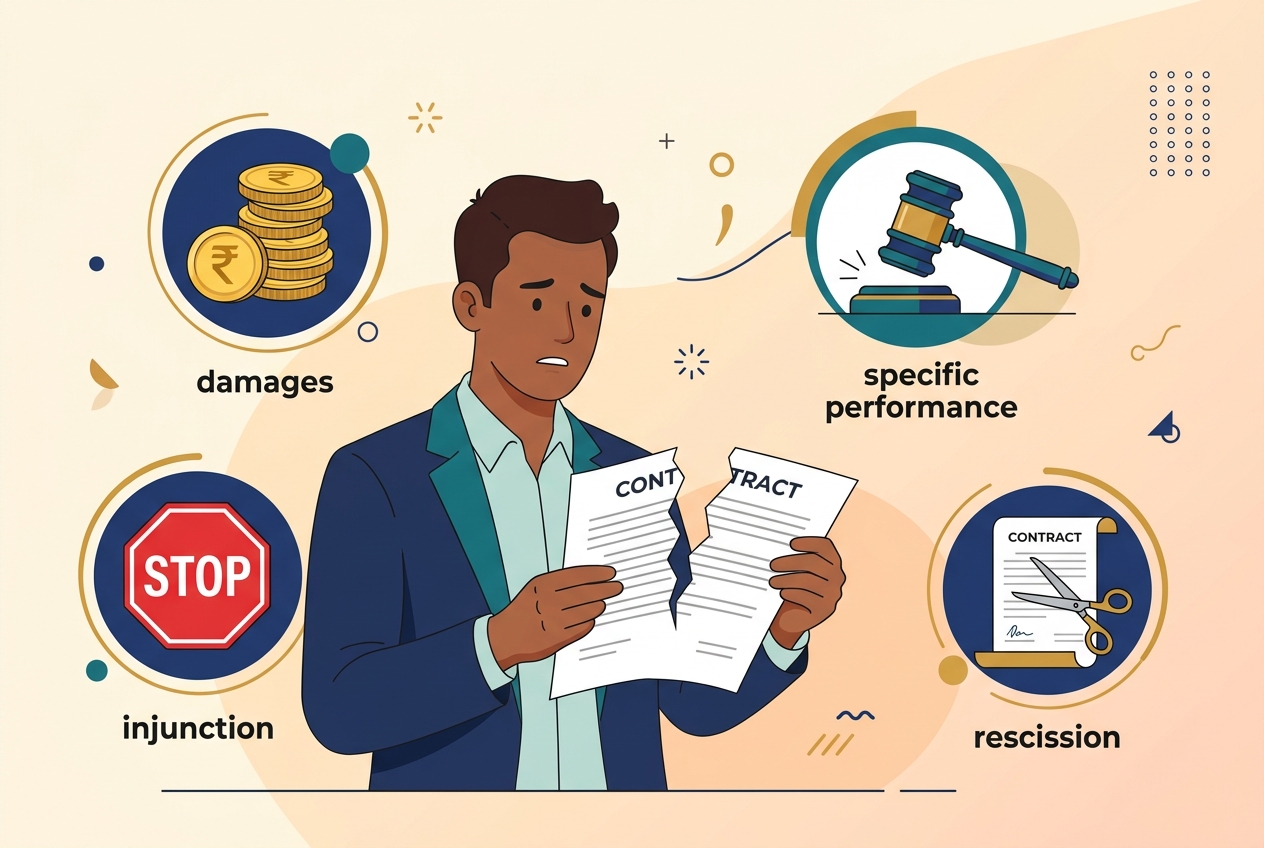
What is an Breach Of Contract In?
A breach of contract occurs when a party fails to perform their obligations under the Indian Contract Act 1872, enabling the non-breaching party to seek damages, specific performance, or contract rescission.
What Constitutes Breach of Contract?
Under the Indian Contract Act 1872, a breach occurs when a party fails to perform their obligations as specified in the contract, without a lawful excuse. The breach can be total (refusing to perform entirely) or partial (performing defectively or incompletely).
Types of Breach
⚡ 1. Actual Breach
Occurs when a party fails to perform on the due date. Two sub-types: Breach at the time of performance (the party simply doesn't deliver when the time comes) and Breach during performance (the party starts performing but does so defectively or incompletely).
⚡ 2. Anticipatory Breach (Section 39)
Occurs when a party declares, before the due date, that they will not perform. The innocent party can either: (a) treat the contract as breached immediately and sue for damages, or (b) wait until the due date and give the party a chance to perform. Key case: Frost v. Knight (1872).
⚡ 3. Fundamental / Material Breach
A breach so significant that it goes to the root of the contract, entitling the innocent party to terminate the contract entirely and claim damages. Example: A software vendor delivers a completely non-functional product.
⚡ 4. Minor / Partial Breach
A breach that doesn't go to the root of the contract. The innocent party cannot terminate but can claim damages for the specific shortfall. Example: A vendor delivers 95 of 100 ordered items on time.
Remedies for Breach of Contract
1. Damages (Sections 73-75)
- Ordinary/General Damages (Section 73): Compensation for loss naturally arising from the breach. Must be foreseeable at the time of contracting.
- Special Damages: Compensation for unusual losses that were communicated to the breaching party at the time of contracting.
- Liquidated Damages (Section 74): Pre-agreed amount in the contract as "reasonable compensation." Courts can reduce it if considered excessive.
- Nominal Damages: Token amount when breach is proved but no actual loss occurred.
Important: Indian law (Section 74) does not distinguish between liquidated damages and penalties as strictly as English law. The court awards "reasonable compensation" not exceeding the stated amount, regardless of the label.
2. Specific Performance (Specific Relief Act 1963)
The court orders the breaching party to actually perform their contractual obligation. Available when:
- Monetary damages are inadequate
- The subject matter is unique (land, rare goods, specific property)
- The contract terms are certain and enforceable
After the 2018 amendment to the Specific Relief Act, specific performance is now the norm rather than the exception for contracts. Courts must grant it unless there are specific grounds to refuse.
3. Injunction
Court order preventing a party from doing something that would breach the contract. Two types:
- Temporary injunction: During the pendency of the suit
- Permanent injunction: Final order after the suit is decided
4. Quantum Meruit
"As much as earned." When a contract is terminated due to breach, the party who has partially performed can claim reasonable compensation for the work already done. Example: A contractor who completes 60% of construction before the owner breaches.
5. Rescission (Section 39)
The innocent party can treat the contract as terminated and refuse further performance. This releases both parties from future obligations but doesn't affect claims for breach that occurred before rescission.
Limitation Period
Under the Limitation Act 1963, you must file a suit for breach of contract within 3 years from the date of breach. Missing this deadline means your claim is time-barred, regardless of its merits.
Protecting Yourself: Contract Drafting Tips
- Include liquidated damages clause: Pre-agree on breach compensation to avoid lengthy damage calculations
- Define "material breach" clearly: List specific events that constitute material breach
- Add cure period: Give the breaching party 15-30 days to fix the breach before you can terminate
- Include force majeure: Protect against breaches caused by events beyond control
- Specify dispute resolution: Arbitration is faster and cheaper than litigation
Don't Sign Blindly. Protect Yourself.
Templates are just a start. Use Contract Shield's AI to scan your contract for hidden risks, unfair clauses, and Indian legal compliance issues — in 60 seconds.
Analyze Your Contract Free →Key Takeaways
- ✅ Breach can be actual, anticipatory, material, or minor
- ✅ Damages are the most common remedy, specific performance is now the default
- ✅ Section 74 gives courts discretion on liquidated damages
- ✅ File suit within 3 years of breach or lose your right
- ✅ Draft contracts with clear breach definitions, cure periods, and remedies
Frequently Asked Questions
What is considered a breach of contract in India?
A breach occurs when a party fails to perform obligations without lawful excuse. Breaches can be actual (failure to perform when due) or anticipatory (one party indicates they will not perform before the deadline). This is subject to the provisions of the Indian Contract Act 1872 and other applicable local regulations, which define the rights, obligations, and legal remedies available to the contracting parties.
What remedies are available for breach of contract in India?
The Indian Contract Act provides three main remedies: damages (monetary compensation under Sections 73-75), specific performance (under the Specific Relief Act 1963), and injunction (court restrains a party from doing something). Such clauses are subject to the Arbitration and Conciliation Act 1996, which provides the legal framework for domestic arbitration, enforcement of awards, and judicial intervention limits in commercial disputes.
Can you claim compensation for mental distress in breach of contract?
Generally no. Indian courts follow the rule that damages must be foreseeable and directly arising from the breach. Mental distress damages are typically not awarded in commercial contracts. Such clauses are subject to the Arbitration and Conciliation Act 1996, which provides the legal framework for domestic arbitration, enforcement of awards, and judicial intervention limits in commercial disputes.
What is the limitation period for breach of contract in India?
Under the Limitation Act 1963, the period is 3 years from the date the breach occurs. For contracts under seal, it is 12 years. Missing the limitation period means the claim becomes time-barred. This is subject to the provisions of the Indian Contract Act 1872 and other applicable local regulations, which define the rights, obligations, and legal remedies available to the contracting parties.
Are electronic signatures legally valid in Indian contracts?
Yes. Under Section 10A of the Information Technology Act 2000, electronic contracts and digital signatures are legally recognized and enforceable. However, certain documents like negotiable instruments, power of attorney, trust deeds, and wills cannot be executed electronically.