Startups & Investments
Shareholder Agreement (SHA) vs AoA: Key Clauses for India
What is an Shareholder Agreement (Sha) Vs Aoa In?
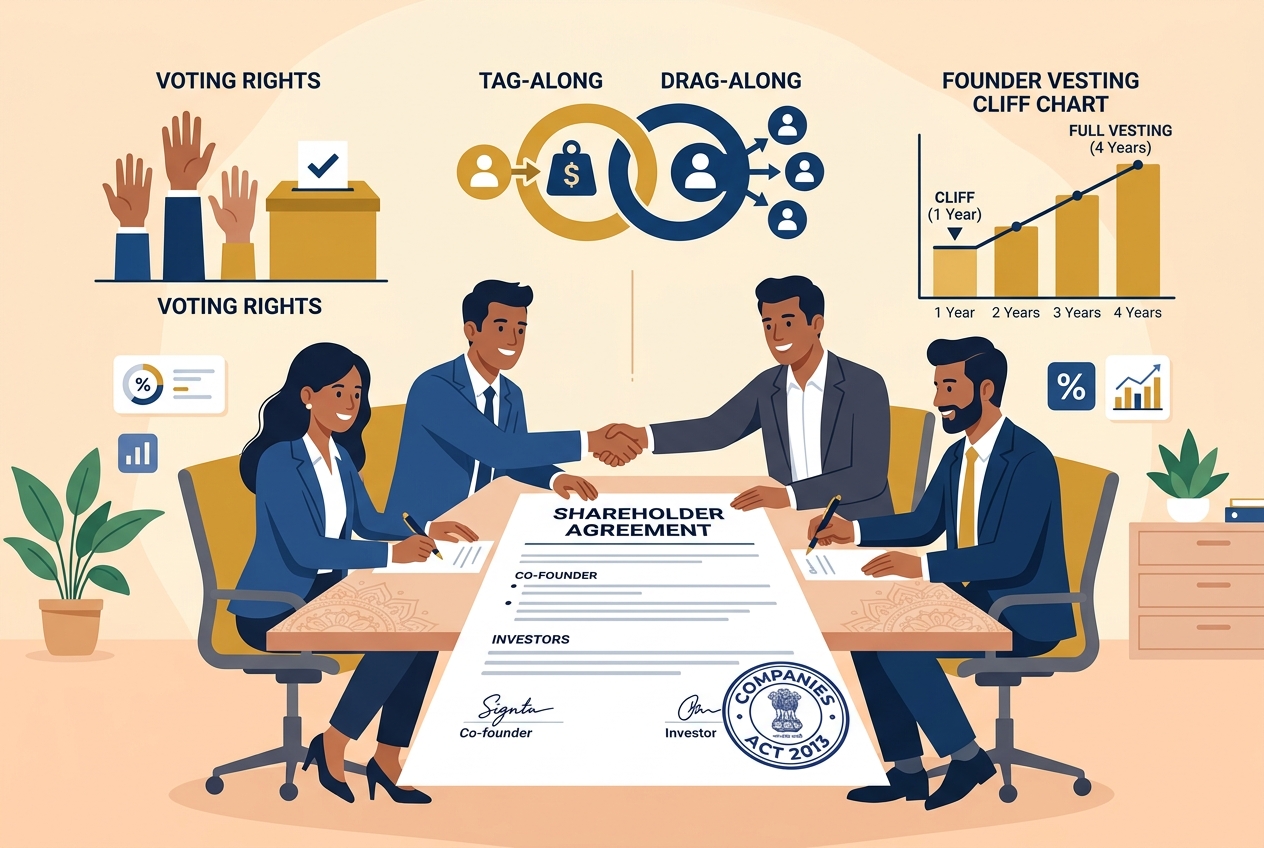
A shareholder agreement (SHA) is a contract among company shareholders defining share transfer restrictions, board representation, voting thresholds, and exit rights.
SHA vs Articles of Association (AoA): Critical Difference
| Feature | Shareholder Agreement (SHA) | Articles of Association (AoA) |
|---|---|---|
| Publicly filed? | No — private document | Yes — filed with MCA, public |
| Binds the company? | Only shareholders (not company) | Binds company AND shareholders |
| Governs | Shareholder relationship, rights | Company's internal governance |
| Conflicts with Companies Act | If invalid, voidable as contract | If invalid, void entirely |
| Amendment process | Shareholder consent | Special resolution + MCA filing |
Key rule: Where SHA and AoA conflict, the AoA prevails. Always align SHA provisions with the AoA, or amend the AoA to match critical SHA terms.
15 Essential Clauses in Every SHA in India
1. Share Capital & Equity Structure
Define authorized share capital, existing share classes (equity, preference, ESOP pool), current cap table, and any conversion rights. This is the foundation of all other clauses.
2. Anti-Dilution Rights
Protects investors against their equity percentage being diluted in down rounds. Two types: Full ratchet (most aggressive — rare in India) and Weighted average (most common). CCPS (Compulsorily Convertible Preference Shares) are the typical vehicle in Indian VC deals.
3. Right of First Refusal (ROFR)
Before any shareholder sells shares to a third party, existing shareholders have the right to purchase at the same terms. Prevents unwanted third parties from entering the cap table. Mandatory in most Indian investors' dealbooks.
4. Tag-Along Rights
If a majority shareholder sells their stake, minority shareholders can "tag along" and sell their shares on the same terms. Protects minority investors from being left with a new majority shareholder they did not choose.
5. Drag-Along Rights
If majority shareholders accept an acquisition offer, they can "drag along" minority shareholders to sell on the same terms. Prevents minority shareholders from blocking a favorable acquisition. Threshold is typically 75%+ of shares (or investor consent).
6. Veto Rights / Reserved Matters
Lists specific decisions that require investor approval regardless of vote count. Common reserved matters: issuing new shares, taking on debt above X crores, changing business scope, asset disposals above X% of net worth, related party transactions, hiring/firing of CXOs.
7. Board Representation
Specifies number of board seats, which shareholders have nomination rights, independent director requirements, and chairman/tie-breaking vote rules. Investor board seats are typically 1 per lead investor in Series A+.
8. Founder Vesting
4-year vesting with 1-year cliff is the standard Indian VC expectation. Define: vesting schedule, acceleration triggers (single-trigger vs double-trigger on acquisition), good leaver/bad leaver definitions — critical for founder equity protection.
9. Liquidation Preference
In a liquidation/exit, who gets paid first and in what order? 1x non-participating preference is investor-friendly but founder-acceptable. 2x+ preferences or full participation rights heavily favor investors and should be negotiated carefully.
10. Confidentiality & Non-Compete
Founders agree not to compete during employment. Post-employment non-competes are void under Section 27 ICA. Include non-solicitation of employees and clients (separately enforceable).
11. IPO / Exit Rights
Timeline expectations for IPO or strategic sale. Include: registration rights (investor's right to include shares in IPO), IPO threshold (minimum valuation), lock-up period post-IPO. SEBI regulations govern actual IPO process.
12. Information Rights
Investor's right to periodic financials, board minutes, management reports, and audit reports. Standard: monthly MIS, quarterly financials, annual audited accounts. Breach of information rights is a trigger for investor action.
13. Dispute Resolution
Most Indian SHA agreements use institutional arbitration (ICC, LCIA, MCIA) under Indian law. Singapore arbitration is common for FDI-funded companies. State: governing law, seat of arbitration, number of arbitrators, language.
14. Representations & Warranties
Founder warranties: company validity, title to shares, no undisclosed liabilities, IP ownership, no pending litigation. Breach triggers indemnification. Negotiate caps (typically 1–3x investment amount) and survival periods.
15. Put Option / Investor Exit
If an IPO or strategic sale doesn't happen within X years, investors may have a put option — right to force buyback of shares at a predetermined return. SEBI regulations significantly restrict put options in Indian companies — take legal advice before including these.
Don't Sign a SHA Without Reviewing It.
Investor term sheets and SHA documents are complex. Use ContractShield to analyze the key risks, missing protections, and imbalanced clauses before signing.
Analyze Your Contract Free →Frequently Asked Questions
What is a shareholder agreement in India?
A shareholder agreement (SHA) in India is a private contract between company shareholders that governs how the company is run, how shares can be transferred, rights of different shareholder classes, and how disputes are resolved. Unlike the Articles of Association (AoA), an SHA is private and not publicly filed. According to Section 10 of the Indian Contract Act 1872, agreements are enforceable only when executed with the free consent of parties competent to contract, for a lawful consideration, and with a lawful object.
What is the difference between SHA and AoA in India?
The Articles of Association (AoA) is a public document filed with the MCA governing the company. A Shareholder Agreement (SHA) is a private contract between shareholders. In case of conflict, the AoA generally prevails since it is the constitutional document. However, contradictory SHA provisions create contractual liability between shareholders. According to Section 10 of the Indian Contract Act 1872, agreements are enforceable only when executed with the free consent of parties competent to contract, for a lawful consideration, and with a lawful object.
What are tag-along and drag-along rights in India?
Tag-along rights allow minority shareholders to join when a majority shareholder sells their stake — ensuring equal exit terms. Drag-along rights allow majority shareholders to force minority shareholders to sell in an acquisition — on the same terms. Both are standard in Indian investor term sheets and SHA clauses. Such clauses are subject to the Arbitration and Conciliation Act 1996, which provides the legal framework for domestic arbitration, enforcement of awards, and judicial intervention limits in commercial disputes.
Is a shareholder agreement legally binding in India?
Yes. A shareholder agreement is a legally binding contract under the Indian Contract Act 1872. It can be enforced through civil courts and arbitration. However, provisions that violate the Companies Act 2013 or the AoA may be unenforceable. Such clauses are subject to the Arbitration and Conciliation Act 1996, which provides the legal framework for domestic arbitration, enforcement of awards, and judicial intervention limits in commercial disputes.
Can a shareholder agreement override the Articles of Association in India?
No. In India, the AoA is the supreme constitutional document of the company. An SHA cannot override the AoA. However, parties can modify the AoA to align with SHA terms. SHA provisions contradicting the AoA create inter-party contractual rights but cannot bind the company. According to Section 10 of the Indian Contract Act 1872, agreements are enforceable only when executed with the free consent of parties competent to contract, for a lawful consideration, and with a lawful object.
Are electronic signatures legally valid in Indian contracts?
Yes. Under Section 10A of the Information Technology Act 2000, electronic contracts and digital signatures are legally recognized and enforceable. However, certain documents like negotiable instruments, power of attorney, trust deeds, and wills cannot be executed electronically.