Legal Tech
AI in the Legal Industry India 2026: Trends, Tools & Transformation
What is an Ai In Legal Industry 2026?
AI contract review software uses machine learning and natural language processing to automatically scan, analyze, and flag red flags in legal agreements, accelerating contract lifecycle management and risk mitigation.
The State of Indian Legal Tech in 2026
The Indian legal tech market has grown from $1.2 billion in 2023 to an estimated $3.5 billion in 2026. Key drivers:
- Supreme Court's push for digitization (e-filing, virtual hearings)
- DPDP Act 2023 creating compliance demand
- Startup ecosystem requiring affordable legal services
- Large language models becoming accurate enough for legal analysis
- Government initiatives like National Judicial Data Grid (NJDG)
5 Areas Where AI is Transforming Legal Work
🤖 1. Contract Review & Analysis
AI tools now review contracts in seconds, flagging risky clauses, missing terms, and non-standard language. What took a junior lawyer 2-3 hours now takes under a minute. Tools like Contract Shield analyze contracts against Indian legal frameworks and industry standards simultaneously.
🤖 2. Legal Research
AI-powered research tools search across Indian case law (Supreme Court, High Courts, Tribunals), statutes, and legal commentary. They can find relevant precedents, summarize judgments, and identify conflicting rulings, tasks that previously required hours in a law library.
🤖 3. Document Drafting
AI drafts contracts, petitions, notices, and legal opinions using templates trained on millions of documents. Key advantage: consistency and compliance with the latest legal requirements. Lawyers review and refine rather than draft from scratch.
🤖 4. Litigation Prediction
Predictive analytics models analyze historical case data to predict outcomes, estimate case duration, and recommend settlement strategies. Particularly useful in insurance, IP, and commercial litigation.
🤖 5. Compliance Monitoring
AI tracks regulatory changes across central and state laws, automatically flags compliance gaps, and generates compliance reports. Essential for businesses navigating India's complex multi-layered regulatory environment.
AI in Indian Courts
The judiciary itself is embracing technology:
- SUPACE (Supreme Court Portal for Assistance in Court's Efficiency): AI tool helping judges process cases by identifying relevant facts and legal issues
- E-Courts Phase III: Digital infrastructure across all district courts, AI-powered case management
- Virtual Hearings: Post-pandemic, hybrid hearings are now standard. AI transcription and translation in real-time
- National Judicial Data Grid: AI analytics on 22+ crore cases for policy insights
Will AI Replace Lawyers?
No. But lawyers who use AI will replace those who don't. Here's what AI can and cannot do:
- ✅ AI can: Review documents, research case law, draft standard contracts, check compliance, predict outcomes based on historical data
- ❌ AI cannot: Exercise legal judgment, provide courtroom advocacy, build client relationships, navigate ethical dilemmas, handle unprecedented legal situations
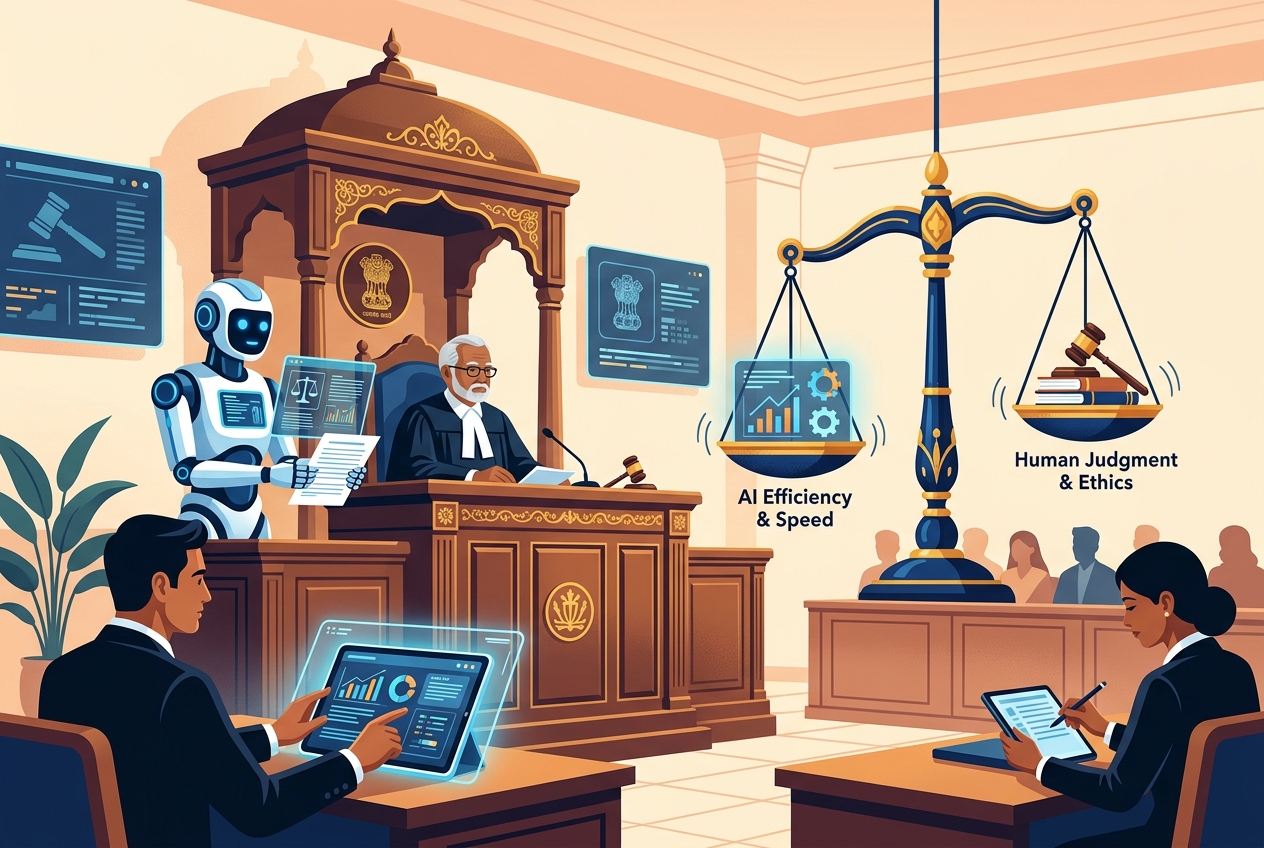
The future belongs to "hybrid lawyers", legal professionals who use AI for efficiency while applying human judgment for strategy and advocacy.
Challenges for Legal AI in India
- Data quality: Indian court records are inconsistent, multilingual, and often poorly digitized
- Language diversity: Legal proceedings in 22+ official languages
- Regulatory uncertainty: No specific AI regulation for legal services yet
- Adoption resistance: Senior lawyers and traditional firms slow to adopt
- Liability questions: Who is liable for AI-generated legal advice?
Don't Sign Blindly. Protect Yourself.
Templates are just a start. Use Contract Shield's AI to scan your contract for hidden risks, unfair clauses, and Indian legal compliance issues — in 60 seconds.
Analyze Your Contract Free →Key Takeaways
- ✅ India's legal tech market is projected at $3.5B in 2026
- ✅ Contract review, legal research, and compliance are AI's strongest areas
- ✅ Indian courts are actively adopting AI through SUPACE and e-Courts
- ✅ AI augments lawyers , it doesn't replace them
- ✅ Lawyers who adopt AI will have a significant competitive advantage
Frequently Asked Questions
How is AI being used in the Indian legal industry?
AI is used for contract review and analysis, legal research, document drafting, due diligence automation, litigation prediction, and compliance monitoring. Such clauses are subject to the Arbitration and Conciliation Act 1996, which provides the legal framework for domestic arbitration, enforcement of awards, and judicial intervention limits in commercial disputes. This is subject to the provisions of the Indian Contract Act 1872 and other applicable local regulations, which define the rights, obligations, and legal remedies available to the contracting parties.
Will AI replace lawyers in India?
No. AI helps legal work rather than replacing lawyers. AI handles repetitive tasks faster, allowing lawyers to focus on strategy, negotiation, and client counseling. This is subject to the provisions of the Indian Contract Act 1872 and other applicable local regulations, which define the rights, obligations, and legal remedies available to the contracting parties.
What are the challenges of AI in Indian law?
Key challenges include lack of specific AI rules, possible bias in training data, accuracy concerns with Indian legal language, data privacy under DPDP Act, and the digital gap between large and small firms. Compliance must align with the Digital Personal Data Protection (DPDP) Act 2023, which imposes obligations on data fiduciaries to obtain explicit consent and implement robust security safeguards for processing personal data.
Is AI contract review accurate?
Modern AI contract review tools achieve 85-95% accuracy for standard clauses. They are good at finding missing clauses and compliance gaps but should work with human review for complex contracts. Such clauses are subject to the Arbitration and Conciliation Act 1996, which provides the legal framework for domestic arbitration, enforcement of awards, and judicial intervention limits in commercial disputes.
Are electronic signatures legally valid in Indian contracts?
Yes. Under Section 10A of the Information Technology Act 2000, electronic contracts and digital signatures are legally recognized and enforceable. However, certain documents like negotiable instruments, power of attorney, trust deeds, and wills cannot be executed electronically.