How-To Guide
How to Draft a Legal Contract in India: Step-by-Step Guide
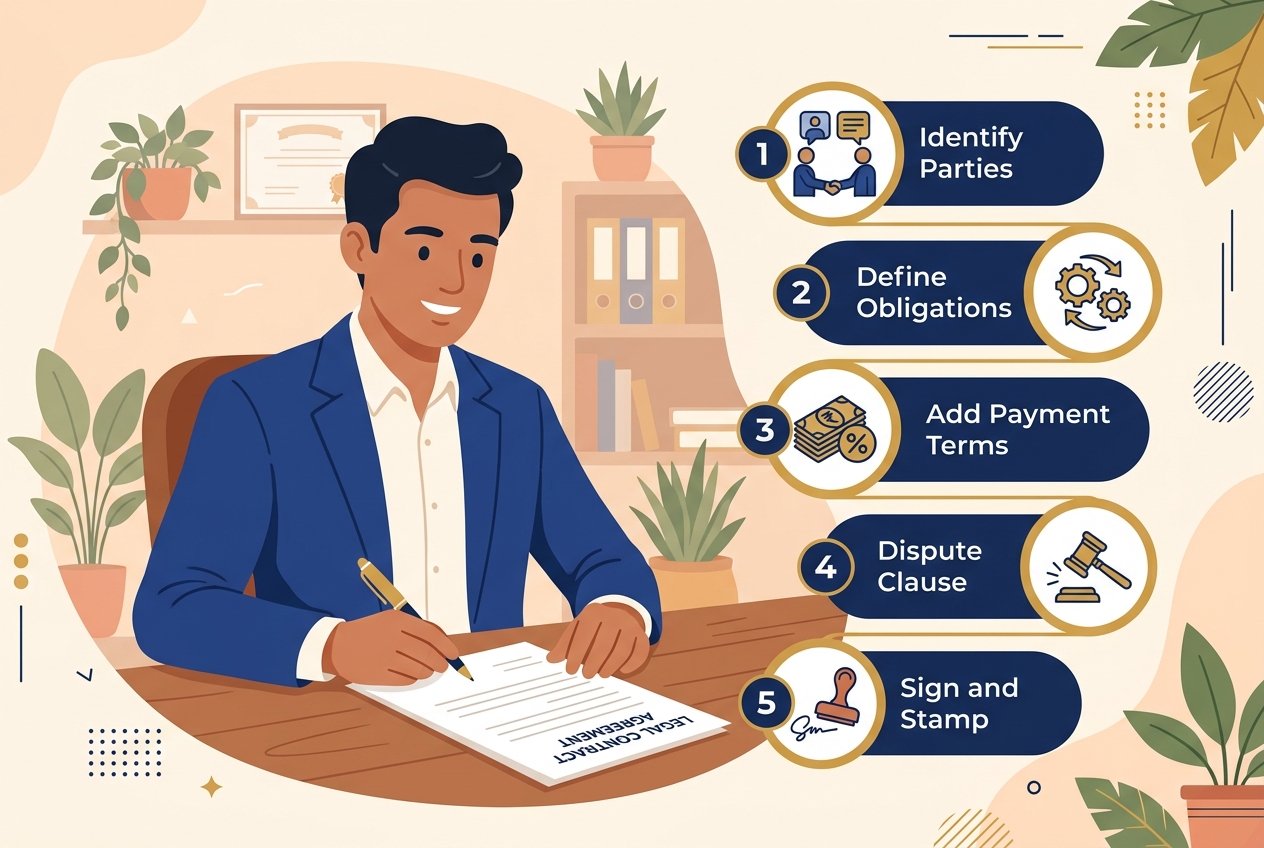
What is an How To Draft A Legal Contract In?
Drafting a contract involves outlining the parties' intent, defining recitals, drafting covenant clauses, defining boilerplate sections, and executing the document in compliance with the Indian Contract Act 1872.
Step 1: Identify the Essential Elements
Under the Indian Contract Act 1872, a valid contract requires:
- Offer (Section 2(a)): One party makes a clear proposal
- Acceptance (Section 2(b)): The other party agrees to the exact terms
- Consideration (Section 2(d)): Something of value exchanged (money, services, goods)
- Capacity (Section 11): Parties must be of legal age (18+), sound mind, and not disqualified by law
- Free Consent (Section 14): No coercion, undue influence, fraud, misrepresentation, or mistake
- Lawful Object (Section 23): The purpose must be legal
Step 2: Structure Your Contract
A well-structured contract follows this standard framework:
📋 Title & Preamble
"SERVICE AGREEMENT" or "SUPPLY CONTRACT" , clearly identify the type. The preamble introduces the parties and the purpose: "This Agreement is entered into on [date] between [Party A] and [Party B] for the purpose of [brief description]."
📋 Recitals (Whereas Clauses)
Background context. "WHEREAS Party A is engaged in the business of..." These aren't legally binding but help interpret the contract's intent if disputed.
📋 Definitions
Define key terms used throughout. "Confidential Information means...", "Deliverables means...", "Effective Date means..." Prevents ambiguity and disputes over meaning.
📋 Operative Clauses
The core terms: scope of work, payment, timelines, obligations, warranties, representations. This is the "meat" of the contract.
📋 Boilerplate Clauses
Standard clauses that appear in most contracts: governing law, jurisdiction, entire agreement, amendment procedure, severability, waiver, notices, assignment, force majeure.
📋 Execution Block
Signature lines for all parties, witness signatures, date of execution, place of execution.
Step 3: Draft Clear, Unambiguous Language
The #1 rule of contract drafting: clarity over elegance.
- ❌ "The party of the first part shall endeavour to..." → ✅ "Party A will..."
- ❌ "Reasonable efforts" (what's reasonable?) → ✅ "Complete within 30 business days"
- ❌ "As soon as possible" → ✅ "Within 5 business days of written notice"
- Use "shall" for obligations, "may" for permissions, "will" for commitments
- Define every term that could be interpreted in more than one way
- Use numbered lists for multiple items (easier to reference in disputes)
Step 4: Include Protective Clauses
- Limitation of Liability: Cap maximum exposure. "Total liability shall not exceed the total fees paid under this Agreement."
- Indemnification: Who covers what? "Party A shall indemnify Party B against claims arising from..."
- Termination for Cause: "Either party may terminate upon 30 days' written notice if the other party materially breaches and fails to cure within 15 days."
- Confidentiality: Protect shared information with specific definitions and survival terms.
- Force Majeure: Cover unforeseeable events. List specific events (pandemic, natural disaster, government action).
Step 5: Review & Finalize
- Read the complete contract aloud , convoluted sentences become obvious
- Check all cross-references match (Section 3.2 actually exists and says what you think)
- Verify all defined terms are actually used (and used consistently)
- Ensure no conflicting clauses exist
- Run it through an AI contract review tool for a quick sanity check
- Have both parties' legal counsel review
Common Drafting Mistakes
- ❌ Copy-pasting from templates without customizing: Every business relationship is unique
- ❌ Using "and/or" ambiguously: Courts have ruled differently on this , be explicit
- ❌ Missing entire agreement clause: Without it, verbal side agreements may be enforceable
- ❌ No stamp duty: Unstamped contracts are inadmissible in court
- ❌ Ignoring state-specific requirements: Contract law varies by state in India (stamp duty, registration)
Don't Sign Blindly. Protect Yourself.
Templates are just a start. Use Contract Shield's AI to scan your contract for hidden risks, unfair clauses, and Indian legal compliance issues — in 60 seconds.
Analyze Your Contract Free →Key Takeaways
- ✅ Every valid contract needs offer, acceptance, consideration, capacity, and consent
- ✅ Structure matters, use clear sections: preamble, definitions, operative, boilerplate
- ✅ Prioritize clarity over legalese
- ✅ Include protective clauses: liability cap, indemnification, termination, force majeure
- ✅ Always stamp and register as required by your state's laws
Frequently Asked Questions
What are the essential elements of a legal contract in India?
Under the Indian Contract Act 1872, a valid contract requires offer and acceptance, free consent, competent parties, lawful consideration, lawful object, and certainty of terms. Compliance must align with the Digital Personal Data Protection (DPDP) Act 2023, which imposes obligations on data fiduciaries to obtain explicit consent and implement robust security safeguards for processing personal data.
What is the difference between a contract and an agreement?
All contracts are agreements, but not all agreements are contracts. An agreement becomes a contract when it is enforceable by law under Section 10 of the Indian Contract Act. This is subject to the provisions of the Indian Contract Act 1872 and other applicable local regulations, which define the rights, obligations, and legal remedies available to the contracting parties.
What are boilerplate clauses in a contract?
Standard provisions including governing law, jurisdiction, force majeure, entire agreement, severability, waiver, assignment restrictions, notices, and amendments. According to Section 10 of the Indian Contract Act 1872, agreements are enforceable only when executed with the free consent of parties competent to contract, for a lawful consideration, and with a lawful object.
Should I use an AI tool or a lawyer to draft contracts?
Both. AI tools are excellent for initial drafting, compliance checks, and identifying missing clauses. For complex or high-value contracts, human legal review is essential. Such clauses are subject to the Arbitration and Conciliation Act 1996, which provides the legal framework for domestic arbitration, enforcement of awards, and judicial intervention limits in commercial disputes.
Are electronic signatures legally valid in Indian contracts?
Yes. Under Section 10A of the Information Technology Act 2000, electronic contracts and digital signatures are legally recognized and enforceable. However, certain documents like negotiable instruments, power of attorney, trust deeds, and wills cannot be executed electronically.