Legal Best Practices
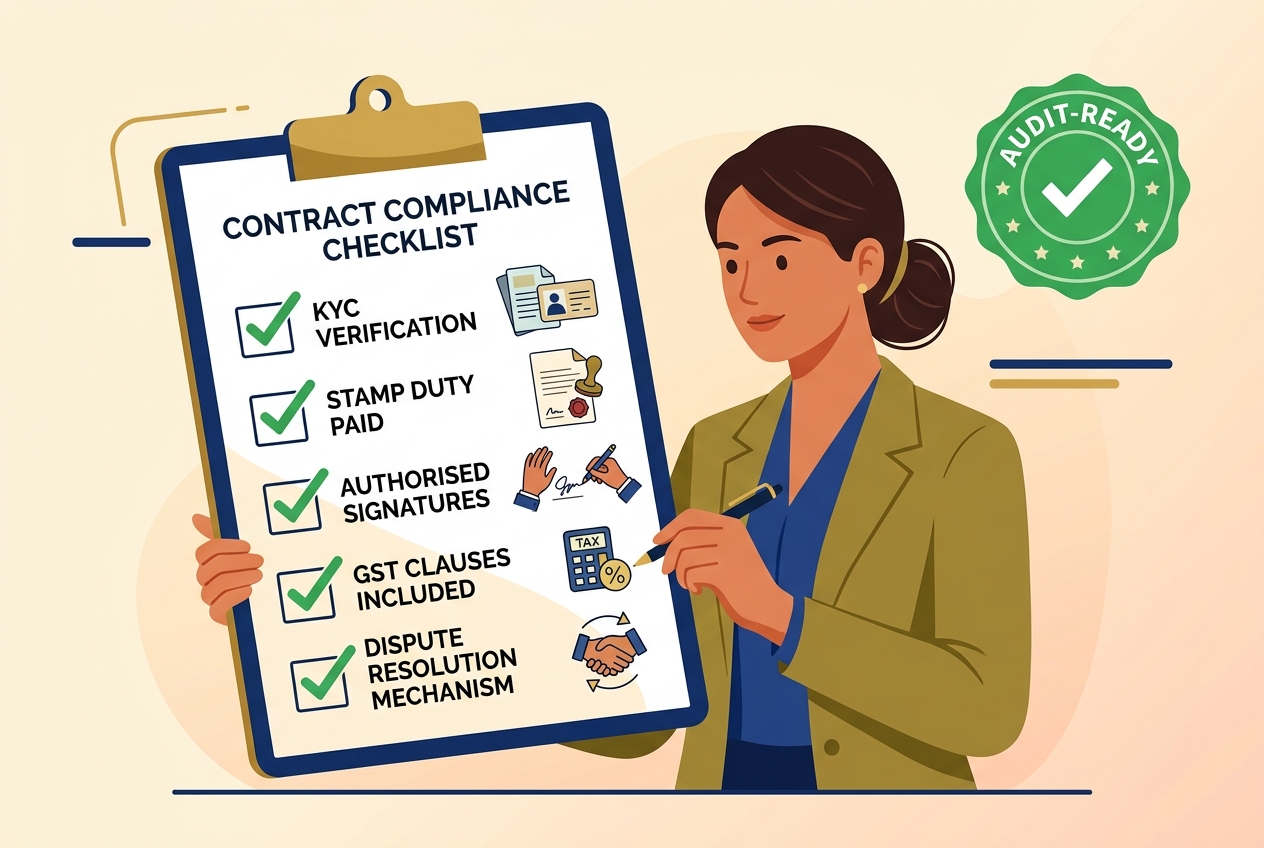
Contract Compliance Checklist: 20 Points to Verify Before Signing
What is an Contract?
Contract compliance is the process of monitoring, verifying, and enforcing that all contracting parties meet their legal, regulatory, and financial obligations throughout the contract lifecycle.
Category A: Party & Authority Verification
☑️ 1. Correct Legal Names
Verify full legal names match government IDs (for individuals) or MCA registration (for companies). "ABC Pvt Ltd" vs "ABC Private Limited" , use the exact registered name.
☑️ 2. Signatory Authority
Confirm the person signing has authority. For companies: check board resolution or power of attorney. For partnerships: check partnership deed for authorization. An unauthorized signature makes the contract voidable.
☑️ 3. Company/Entity Status
Verify the entity is active on MCA portal (not struck off, dissolved, or under liquidation). For LLPs: check on LLP portal. For foreign entities: verify local registration or foreign qualification.
☑️ 4. Registered Address
Ensure the registered address matches official records. This is the address where legal notices will be sent. Verify notice delivery mechanism (email + physical copy recommended).
Category B: Core Terms
☑️ 5. Clear Scope of Work
Deliverables must be specific and measurable. "Develop an app" is vague. "Develop an iOS and Android app with X features, Y screens, meeting Z specifications" is enforceable.
☑️ 6. Payment Terms
Amount, currency, schedule (milestone-based recommended), payment method, invoice format, TDS applicability, GST breakout, and late payment interest rate.
☑️ 7. Timeline & Milestones
Start date, end date, key milestones with specific dates, and consequences of delay. Include buffer for dependencies outside your control.
☑️ 8. Warranties & Representations
What each party guarantees. Check for hidden warranty disclaimers like "as is" or "without warranty." Ensure warranties survive the contract term.
Category C: Risk & Liability
☑️ 9. Limitation of Liability
Check the cap on total liability. Common: limited to contract value or fees paid in last 12 months. Ensure carve-outs for fraud, willful misconduct, IP infringement, and confidentiality breaches.
☑️ 10. Indemnification
Is it mutual or one-sided? What triggers indemnification? Is there a process for claims (notice, defense, settlement)? Include caps on indemnification amounts.
☑️ 11. Insurance Requirements
Professional liability, general liability, cyber insurance. Verify the other party maintains adequate coverage for the contract value and duration.
☑️ 12. Force Majeure
List of covered events (natural disasters, pandemics, government actions, war). Notice requirements. Impact on obligations. Post-pandemic: ensure "pandemic/epidemic" is explicitly listed.
Category D: IP & Confidentiality
☑️ 13. IP Ownership
Who owns the work product? Background IP vs foreground IP. License rights upon termination. Open-source component disclosure.
☑️ 14. Confidentiality/NDA
Definition of confidential information. Exclusions. Duration (typically 2-5 years, or perpetual for trade secrets). Return/destruction of materials upon termination.
☑️ 15. Data Protection
DPDP Act 2023 compliance. Data processing terms. Cross-border transfer restrictions. Breach notification timelines. Data retention and deletion policies.
Category E: Termination & Disputes
☑️ 16. Termination Rights
Termination for cause (material breach + cure period). Termination for convenience (notice period + termination fees). Effect of termination on accrued rights and obligations.
☑️ 17. Notice Period
How much notice is required? Written vs email. When is notice deemed received? Ensure notice addresses are current and include email as an additional method.
☑️ 18. Dispute Resolution
Escalation mechanism (negotiation → mediation → arbitration/litigation). Arbitration seat and rules. Number of arbitrators. Governing law. Emergency interim relief provisions.
☑️ 19. Governing Law & Jurisdiction
Which state/country's law governs? Which courts have jurisdiction? For cross-border: check enforceability of foreign judgments/awards in India.
☑️ 20. Stamp Duty & Registration
Is the contract properly stamped per state requirements? Does it need registration (agreements over 11 months involving immovable property)? Unstamped agreements are inadmissible as evidence in court.
Don't Sign Blindly. Protect Yourself.
Templates are just a start. Use Contract Shield's AI to scan your contract for hidden risks, unfair clauses, and Indian legal compliance issues — in 60 seconds.
Analyze Your Contract Free →Key Takeaways
- ✅ Always verify signatory authority before signing
- ✅ Scope, payment, and timeline must be specific and measurable
- ✅ Check liability caps and indemnification , one-sided terms are red flags
- ✅ IP ownership and confidentiality need explicit, detailed clauses
- ✅ Ensure proper stamp duty and registration for enforceability
- ✅ Never skip dispute resolution , arbitration saves time and money
Frequently Asked Questions
What should I check before signing a contract?
Key items: correct legal names, clear scope of work, payment terms, liability caps, indemnification clauses, termination conditions, dispute resolution, confidentiality obligations, and governing law. Under Section 194J of the Income Tax Act 1961, tax at source (TDS) at 10% must be deducted on professional services fees exceeding Rs 30,000 per financial year, failing which the deductor faces interest penalties.
What makes a contract legally enforceable in India?
Under Section 10 of the Indian Contract Act 1872, a valid contract requires free consent of competent parties, lawful consideration, lawful object, and must not be expressly declared void. Compliance must align with the Digital Personal Data Protection (DPDP) Act 2023, which imposes obligations on data fiduciaries to obtain explicit consent and implement robust security safeguards for processing personal data.
What are contract red flags to watch for?
Watch for one-sided indemnification, unlimited liability, automatic renewal without notice, overly broad non-compete clauses, vague scope, missing termination rights, and clauses allowing unilateral amendments. This is governed by Section 27 of the Indian Contract Act 1872, which declares any agreement in restraint of trade, business, or profession as void, meaning post-employment non-competes are legally unenforceable in Indian courts.
How often should contracts be reviewed?
At least annually or at each renewal date. Also review when laws change (like the DPDP Act 2023), when business relationships change, or when performance issues arise. Compliance must align with the Digital Personal Data Protection (DPDP) Act 2023, which imposes obligations on data fiduciaries to obtain explicit consent and implement robust security safeguards for processing personal data.
Are electronic signatures legally valid in Indian contracts?
Yes. Under Section 10A of the Information Technology Act 2000, electronic contracts and digital signatures are legally recognized and enforceable. However, certain documents like negotiable instruments, power of attorney, trust deeds, and wills cannot be executed electronically.