M&A & Investments
Due Diligence Contract Review India: M&A, Investments & Partnerships
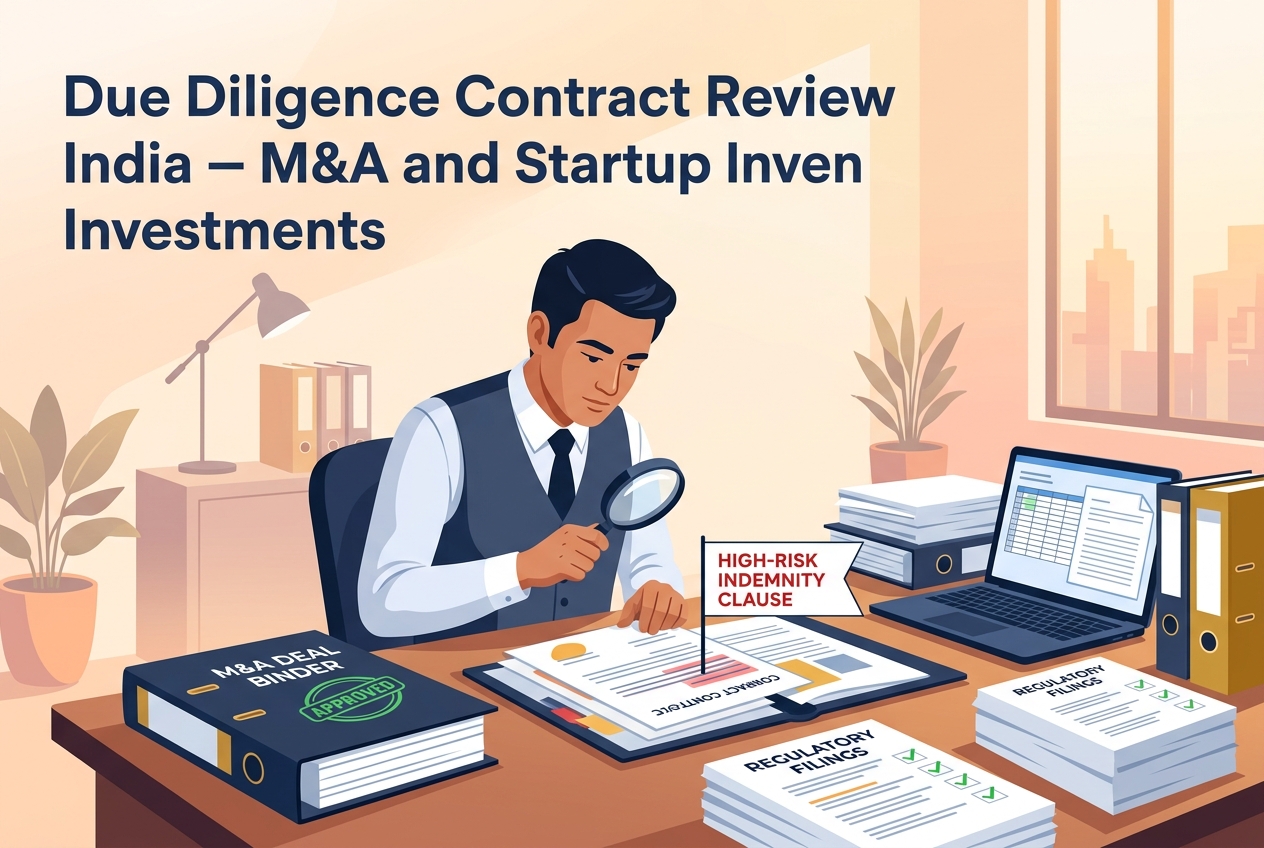
What is an Due Diligence Contract?
Legal due diligence is the comprehensive review of a target entity's corporate, financial, contractual, and regulatory records to identify potential liabilities before an acquisition, investment, or merger.
What Contract Due Diligence Covers
Contract DD reviews the target's legal obligations across:
- Revenue contracts (customer agreements, subscription contracts)
- Supply chain (vendor, distributor, logistics agreements)
- Employment (key employee contracts, ESOPs, non-competes, bonds)
- IP agreements (licenses, assignments, software agreements)
- Financing (loan agreements, security documents)
- Real estate (leases, property agreements)
- Joint ventures and partnerships
- Regulatory and compliance agreements
Priority 1: Change-of-Control Clauses
⚠️ The Most Dangerous Clause in M&A
A change-of-control clause gives the counterparty the right to terminate or renegotiate a contract if ownership or control of the contracting company changes. In M&A, if a key customer contract has CoC provisions, you need their consent before closing. Missed CoC clauses have derailed significant Indian M&A deals — review every material contract for assignment and CoC provisions.
Priority 2: IP Ownership and License Chain
Many Indian startups use open-source code, licensed APIs, and offshore development teams — creating a messy IP chain:
- Is all software IP formally assigned to the company? (Check: all developer contracts, including freelancers)
- Are open-source license requirements met? (GPL contamination risk)
- Are customer data rights protected? No customer contracts granting excessive data rights to customers?
- Are all trademark registrations in the company's name? Not founder's personal name?
Priority 3: Revenue Quality and Customer Contracts
Revenue Sustainability Red Flags
Look for: single-customer concentration (1 customer = 30%+ revenue), short-term/auto-renewing contracts vs multi-year locked, termination for convenience clauses (customer can exit with 30 days notice), unfavorable pricing terms, or contracts that lose key provisions post-change-of-control.
The DD Checklist: Contract Review Priorities
- ✅ Identify material contracts — all agreements above a threshold value (e.g., ₹50 lakhs/year) or with counterparties representing >5% of revenue
- ✅ Change-of-control review — flag all contracts with CoC/assignment restrictions
- ✅ Termination rights — can counterparties exit without cause? What's the notice period?
- ✅ IP review — trace ownership of all IP: who assigned what, when, from whom
- ✅ Employment liabilities — bonds, ESOPs, non-competes, golden parachutes
- ✅ Compliance — FEMA, SEBI, RBI, sector-specific licenses — all current and transferable
- ✅ Litigation risk — identify ongoing disputes, previous settlement agreements, non-disparagement clauses
- ✅ Representations and warranties exposure — map all warranties given in existing contracts that the acquirer will inherit
MAC/MAE Clauses in Indian M&A
Most Indian M&A agreements include a Material Adverse Change (MAC) clause between signing and closing:
- Triggered by: Significant revenue loss, key contract termination, regulatory action, material litigation
- Typically excluded: Industry-wide downturns, general economic conditions (COVID was heavily litigated globally), regulatory changes affecting all players, market decline
- Heavily negotiated: What constitutes "material" — often defined as X% revenue decline or specific dollar/rupee threshold
AI-Powered Contract Due Diligence
Traditional DD on 200+ contracts takes weeks and costs lakhs in lawyer time. AI contract review tools can:
- Automatically extract key clauses from all contracts in hours
- Flag change-of-control, termination, and assignment provisions
- Generate summary risk matrices for each contract
- Identify unusual clauses vs market standard benchmarks
- Reduce lawyer review time by 60–80%, focusing attention on high-risk contracts
Preparing for M&A Due Diligence?
ContractShield helps companies review contracts 10x faster — identifying change-of-control triggers, IP gaps, liability exposure, and problematic clauses automatically.
Start Free Contract Analysis →Frequently Asked Questions
What is contract due diligence in M&A?
Contract due diligence in M&A is the process of systematically reviewing all material contracts of a target company to identify risks, liabilities, change-of-control provisions, assignment restrictions, and obligations that could affect the deal value, structure, or post-merger integration. It is a standard component of legal due diligence in any Indian M&A transaction.
What are the most important contracts to review during M&A due diligence?
Priority contracts include: customer contracts (revenue sustainability), supplier/vendor agreements (cost structure), employment contracts (key person risk, non-competes), IP assignments and licenses, loan agreements (change-of-control triggers), equity documents (SHA, term sheets), regulatory licenses, and real estate leases. Specifically, Section 17 of the Copyright Act 1957 stipulates that the creator is the first owner of copyright unless there is a written contract assigning these rights to another entity, such as an employer or client.
What is a change-of-control clause in a contract?
A change-of-control clause allows the counterparty to terminate or renegotiate a contract if there is a change in ownership or control of the contracting party. In M&A, these clauses in key customer and supplier contracts can be deal-breakers — if triggered, they require counterparty consent before closing. Specifically, Section 17 of the Copyright Act 1957 stipulates that the creator is the first owner of copyright unless there is a written contract assigning these rights to another entity, such as an employer or client.
What is a Material Adverse Change (MAC) clause in India?
A Material Adverse Change (MAC) or Material Adverse Effect (MAE) clause allows a buyer to walk away from an Indian M&A deal if the target company experiences a significant deterioration between signing and closing. What constitutes a MAC is heavily negotiated — industry downturns, general economic conditions, and regulatory changes are typically excluded.
How long does contract due diligence take in India?
For a startup with 50–200 key contracts: 2–4 weeks with a dedicated legal team. For a mid-size company with 500+ contracts: 6–12 weeks. AI-powered contract review tools can cut initial review time by 60–80%, allowing lawyers to focus on high-risk contracts identified automatically. This is subject to the provisions of the Indian Contract Act 1872 and other applicable local regulations, which define the rights, obligations, and legal remedies available to the contracting parties.
Are electronic signatures legally valid in Indian contracts?
Yes. Under Section 10A of the Information Technology Act 2000, electronic contracts and digital signatures are legally recognized and enforceable. However, certain documents like negotiable instruments, power of attorney, trust deeds, and wills cannot be executed electronically.