Indian Law
Limitation Act & Contracts India: Time Limits to Sue for Breach
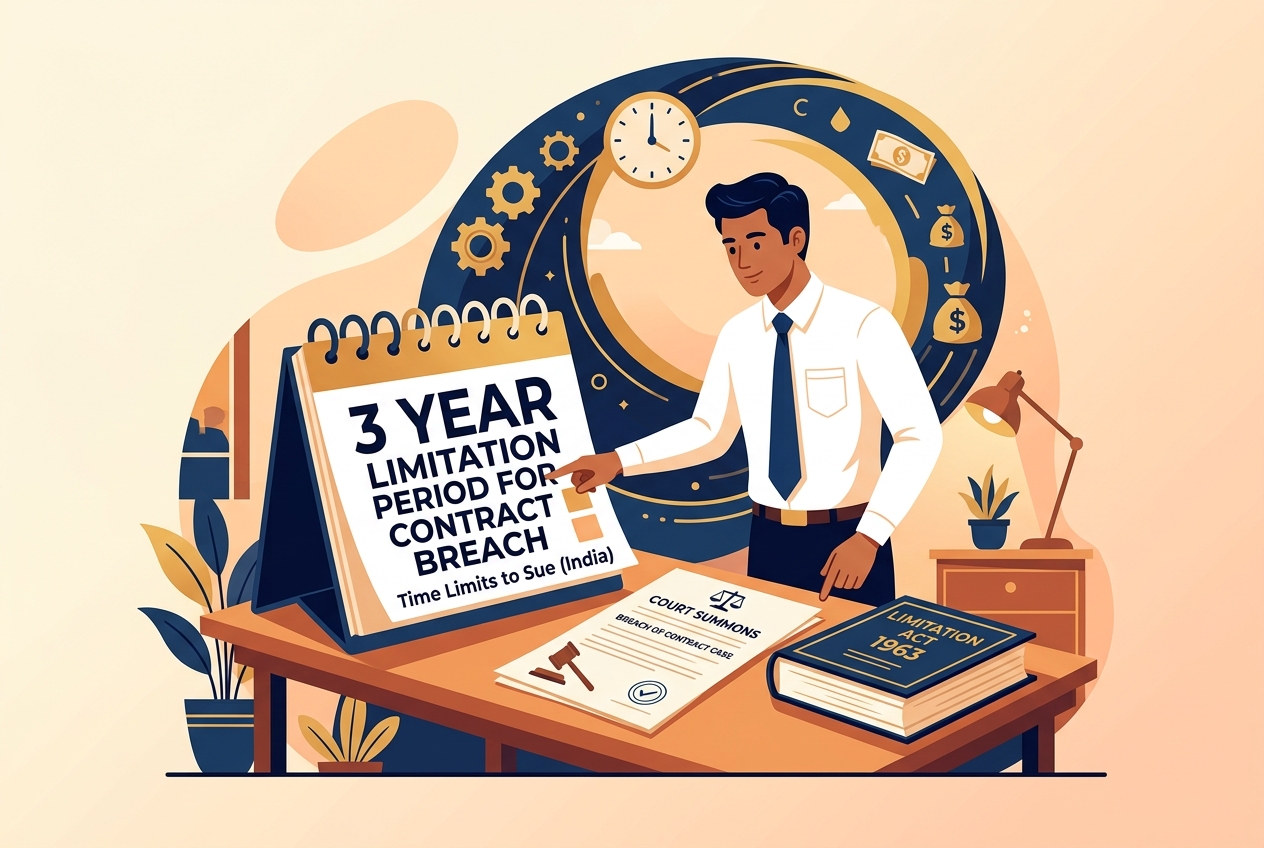
⏰ The 3-Year Rule
You have 3 years from the date of breach to file a suit for breach of contract in India under Article 55 of the Limitation Act 1963. Miss this window and your claim is permanently time-barred.
What is an Limitation Act & Contracts?
The Limitation Act 1963 defines the legal time limits within which a party must file a lawsuit or claim in court (typically 3 years for breach of contract claims in India).
Limitation Periods for Common Contract Disputes
| Type of Claim | Limitation Period | Starts From |
|---|---|---|
| Breach of contract (general) | 3 years | Date of breach |
| Recovery of money lent | 3 years | Date of demand / loan date |
| Promissory note / bill of exchange | 3 years | Date due for payment |
| Specific performance of contract | 3 years | Date fixed for performance |
| Fraud in contract | 3 years | When fraud was/could have been discovered |
| Contract for immovable property | 12 years | Date of breach |
| Arbitration award enforcement | 12 years | Date of award |
When Does the Limitation Clock Start?
The limitation period begins when the cause of action accrues — typically the date the breach occurred or the obligation was to be performed.
- Payment due date: If an invoice was due on Jan 1, 2023, the 3-year clock started Jan 1, 2023 — not when demand was made
- Continuing breach: A fresh cause of action arises each day for ongoing breaches (e.g., failure to pay monthly installments)
- Latent defect: For hidden defects, the clock may start from the date of discovery
- Anticipatory breach: The date the party communicated refusal to perform
How to Restart the Limitation Clock
1. Written Acknowledgment (Section 18, Limitation Act)
If the debtor acknowledges the debt in writing — even in an email or WhatsApp message — before the limitation period expires, a fresh 3-year period starts from that date. The acknowledgment must be signed and clearly identify the liability.
2. Part Payment (Section 19, Limitation Act)
If the debtor makes any payment toward the debt before the limitation period expires, a fresh limitation period starts from the date of payment. Even a small payment qualifies — maintain bank records of all partial payments with dates.
3. New Promise (Section 25(3), Indian Contract Act)
A new written and signed promise to pay a time-barred debt creates an enforceable contract for the amount promised, creating an entirely new cause of action.
Contractual Clauses and Limitation
- ❌ Cannot shorten: Section 28 of the Indian Contract Act voids any clause that shortens the limitation period
- ✅ Can extend: Courts allow contractual provisions that extend limitation beyond the statutory minimum
- ✅ Notice clauses help: Include "notice of breach within 30 days" clauses to establish breach dates clearly
Limitation in Arbitration
The Limitation Act applies to arbitration (Section 43, Arbitration and Conciliation Act 1996). The same 3-year clock applies. Filing a civil suit for an arbitration-covered dispute does not stop the arbitration clock — you must file the arbitration notice separately. Sending an arbitration invocation notice within the 3-year period stops the clock for the arbitration claim.
Practical Tips for Businesses
- Track all contract performance dates — know exactly when each obligation was due
- Act on defaults within 6 months — send legal notice early to preserve rights
- Get written acknowledgments — insist on written confirmation of outstanding dues
- Document all part payments with dates and bank references
- Invoke arbitration early — technical issues can delay filing
Protect Your Contract Rights.
Use ContractShield to analyze your contracts for missing dispute notice provisions and unclear payment terms — before you sign.
Analyze Your Contract Free →Key Takeaways
- ✅ General breach of contract limitation in India: 3 years from breach date
- ✅ Immovable property contracts: 12 years; arbitration award: 12 years
- ✅ Written acknowledgment or part payment before expiry restarts the clock
- ✅ Contractual shortening of limitation period is void under Section 28, ICA
- ✅ Always send a legal notice well before limitation expires
Frequently Asked Questions
How long do you have to sue for breach of contract in India?
Under Article 55 of the Limitation Act 1963, you have 3 years from the date of breach to file a suit. For immovable property contracts the period is 12 years. This is subject to the provisions of the Indian Contract Act 1872 and other applicable local regulations, which define the rights, obligations, and legal remedies available to the contracting parties.
Can the limitation period be extended in India?
Yes — by written acknowledgment of debt (Section 18), part payment (Section 19), or a new written promise to pay under Section 25(3) of the Indian Contract Act. According to Section 10 of the Indian Contract Act 1872, agreements are enforceable only when executed with the free consent of parties competent to contract, for a lawful consideration, and with a lawful object.
Can parties contractually reduce the limitation period?
No. Section 28 of the Indian Contract Act voids any agreement that shortens the limitation period. Parties CAN extend it beyond the statutory minimum. According to Section 10 of the Indian Contract Act 1872, agreements are enforceable only when executed with the free consent of parties competent to contract, for a lawful consideration, and with a lawful object.
Does limitation apply to arbitration in India?
Yes. Section 43 of the Arbitration and Conciliation Act 1996 applies the Limitation Act to arbitration proceedings. The same 3-year clock applies. This is subject to the provisions of the Indian Contract Act 1872 and other applicable local regulations, which define the rights, obligations, and legal remedies available to the contracting parties.
Are electronic signatures legally valid in Indian contracts?
Yes. Under Section 10A of the Information Technology Act 2000, electronic contracts and digital signatures are legally recognized and enforceable. However, certain documents like negotiable instruments, power of attorney, trust deeds, and wills cannot be executed electronically.